Chapter 11: Electricity
Uncover the laws governing the flow of electric charges. Learn about current, electric potential, Ohm's law, series and parallel circuits, heating effects, and electric power calculations that run modern appliances. Electric charges के बहाव (flow) को govern करने वाले नियमों (laws) को समझें। Current, electric potential, Ohm's law, series and parallel circuits, heating effects, और modern appliances को चलाने वाले electric power calculations के बारे में सीखें।
💡 Remember from before:
- In Chapter 9 and 10, we learned how light acts as an energy source. Now we explore electrical energy. Chapter 9 और 10 में हमने सीखा था कि light कैसे एक energy source की तरह काम करती है। अब हम electrical energy को explore करेंगे।
- Matter is composed of atoms, which contain positively charged protons and negatively charged electrons. सारे matter atoms से मिलकर बने हैं, जिनमें positively charged protons और negatively charged electrons होते हैं।
- Electric charge is a fundamental property of matter, and the flow of electrons produces electric current. Electric charge matter की एक fundamental property (मूल गुण) है, और electrons का flow ही electric current produce करता है।
1. Electric Current and Circuit (विद्युत धारा और परिपथ)
Electric charge (charge) is a fundamental property of particles. The SI unit of electric charge is the coulomb (C). One coulomb is equivalent to the charge contained in nearly 6 × 10¹⁸ electrons. An electron possesses a negative charge of 1.6 × 10⁻¹⁹ C [NCERT p.186]. Electric charge (charge) particles की एक fundamental property है। Electric charge का SI unit coulomb (C) होता है। एक coulomb लगभग 6 × 10¹⁸ electrons में मौजूद charge के बराबर होता है। एक electron पर 1.6 × 10⁻¹⁹ C का negative charge होता है [NCERT p.186]।
Electric current (electric current) is defined as the rate of flow of electric charge through a cross-section. If a net charge Q flows through any cross-section of a conductor in time t, then the current I is [NCERT p.186]: Electric current (electric current) को किसी cross-section से बहने वाले electric charge के flow के rate (दर) के रूप में define किया जाता है। यदि conductor के cross-section से समय t में net charge Q बहता है, तो current I होगा [NCERT p.186]:
I = Q / t
The SI unit of electric current is the ampere (A), named after the French scientist André-Marie Ampère. One ampere is constituted by the flow of one coulomb of charge per second, i.e., 1 A = 1 C/s [NCERT p.186]. Small quantities of current are expressed in milliampere (1 mA = 10-3 A) or microampere (1 μA = 10-6 A). Electric current का SI unit ampere (A) है, जिसे French scientist André-Marie Ampère के नाम पर रखा गया है। एक ampere current प्रति second एक coulomb charge के flow से बनता है, यानी 1 A = 1 C/s [NCERT p.186]। Current की छोटी quantities को milliampere (1 mA = 10-3 A) या microampere (1 μA = 10-6 A) में express किया जाता है।
Conventional Current Direction: Historically, when electricity was discovered, electrons were not known. Current was considered to be the flow of positive charges, and the direction of flow of positive charges was taken to be the direction of electric current. Conventionally, in an electric circuit, the direction of electric current is taken as opposite to the direction of the flow of electrons (which are negative charges) [NCERT p.186]. Conventional Current Direction: Historically, जब electricity की खोज हुई, तब electrons के बारे में पता नहीं था। इसलिए, current को positive charges का flow माना गया और उनके flow की direction को ही electric current की direction मान लिया गया। Conventionally, किसी electric circuit में electric current की direction को electrons के flow की direction के opposite (जो कि negative charges हैं) माना जाता है [NCERT p.186]।
An electric circuit (electric circuit) is a closed and continuous path of an electric current. If the path is broken anywhere (or the switch is turned OFF), the current stops flowing and the appliances do not work [NCERT p.186]. An instrument called an ammeter (ammeter) is used to measure electric current in a circuit. It is always connected in series in a circuit because it has a very low resistance and needs all current to pass through it [NCERT p.187]. एक electric circuit (electric circuit) electric current का एक closed (बंद) और continuous path (सतत मार्ग) होता है। यदि path कहीं से भी टूट जाए (या switch बंद हो जाए), तो current बहना बंद हो जाता है और appliances काम नहीं करते [NCERT p.186]। Circuit में current measure करने के लिए ammeter (ammeter) नामक instrument का उपयोग किया जाता है। इसे circuit में हमेशा series (series) में जोड़ा जाता है क्योंकि इसका resistance बहुत कम होता है और इसे पूरे current को अपने अंदर से गुजारना होता है [NCERT p.187]।
⚡ Checkpoint 1: Electric Current & Charge
Section SummarySection Summary (अनुभाग सारांश)
- Charge SI Unit: Coulomb (C). 1 electron = -1.6 × 10⁻¹⁹ C. Charge SI Unit: Coulomb (C). 1 electron = -1.6 × 10⁻¹⁹ C.
- Current (I = Q/t): Flow of charge per unit time. Unit: Ampere (A). 1 A = 1 C/s. Current (I = Q/t): प्रति unit time में charge का बहाव। Unit: Ampere (A). 1 A = 1 C/s.
- Direction: Opposite to the flow of electrons (from positive to negative terminal). Direction: Electrons के flow के opposite (positive terminal से negative terminal की ओर)।
- Ammeter: Connected in series to measure current; has low resistance. Ammeter: Current measure करने के लिए series में जोड़ा जाता है; इसका resistance कम होता है।
2. Electric Potential and Potential Difference (विद्युत विभव और विभवांतर)
What makes the electric charge flow? For flow of charges in a conducting metallic wire, the gravity itself has no role to play; the electrons move only if there is a difference of electric pressure – called the electric potential difference (potential difference) along the conductor [NCERT p.187]. Electric charge को क्या बहने पर मजबूर करता है? किसी conducting metallic wire में charges के flow के लिए gravity का कोई role नहीं होता; electrons तभी move करते हैं जब वहाँ electric pressure में अंतर हो — जिसे conductor के साथ electric potential difference (potential difference) कहा जाता है [NCERT p.187]।
We define the electric potential difference between two points in an electric circuit carrying some current as the work done to move a unit charge from one point to the other [NCERT p.188]: हम current-carrying electric circuit के दो points के बीच electric potential difference को एक point से दूसरे point तक unit charge को ले जाने में किए गए work done के रूप में define करते हैं [NCERT p.188]:
V = W / Q
The SI unit of electric potential difference is the volt (V), named after Alessandro Volta. One volt is defined as the potential difference between two points in a current-carrying conductor when one joule of work is done to move a charge of one coulomb from one point to the other, i.e., 1 V = 1 J/C [NCERT p.188]. Electric potential difference का SI unit volt (V) है, जिसे Alessandro Volta के नाम पर रखा गया है। जब 1 coulomb charge को एक point से दूसरे point तक ले जाने में 1 joule का work done होता है, तो उन दो points के बीच potential difference को 1 volt कहा जाता है, यानी 1 V = 1 J/C [NCERT p.188]।
The potential difference is measured by an instrument called the voltmeter (voltmeter). The voltmeter is always connected in parallel across the points between which the potential difference is to be measured because it has a very high resistance and takes negligible current from the circuit [NCERT p.188]. Potential difference को voltmeter (voltmeter) नामक instrument से measure किया जाता है। Voltmeter को हमेशा उन points के cross parallel (parallel) में जोड़ा जाता है जिनके बीच potential difference measure करना हो, क्योंकि इसका resistance बहुत high होता है और यह circuit से न के बराबर current लेता है [NCERT p.188]।
⚡ Checkpoint 2: Potential DifferenceCheckpoint 2: potential difference
Section SummarySection Summary (अनुभाग सारांश)
- Potential Difference (V = W/Q): Work done per unit charge. Unit: Volt (V). 1 V = 1 J/C. Potential Difference (V = W/Q): प्रति unit charge पर किया गया work done। Unit: Volt (V)। 1 V = 1 J/C।
- Source: Chemical action inside a cell or battery maintains the potential difference. Source: Cell या battery के अंदर की chemical action potential difference को maintain रखती है।
- Voltmeter: Connected in parallel; has high resistance. Voltmeter: Parallel में जोड़ा जाता है; इसका resistance बहुत high होता है।
3. Ohm's Law (ओम का नियम)
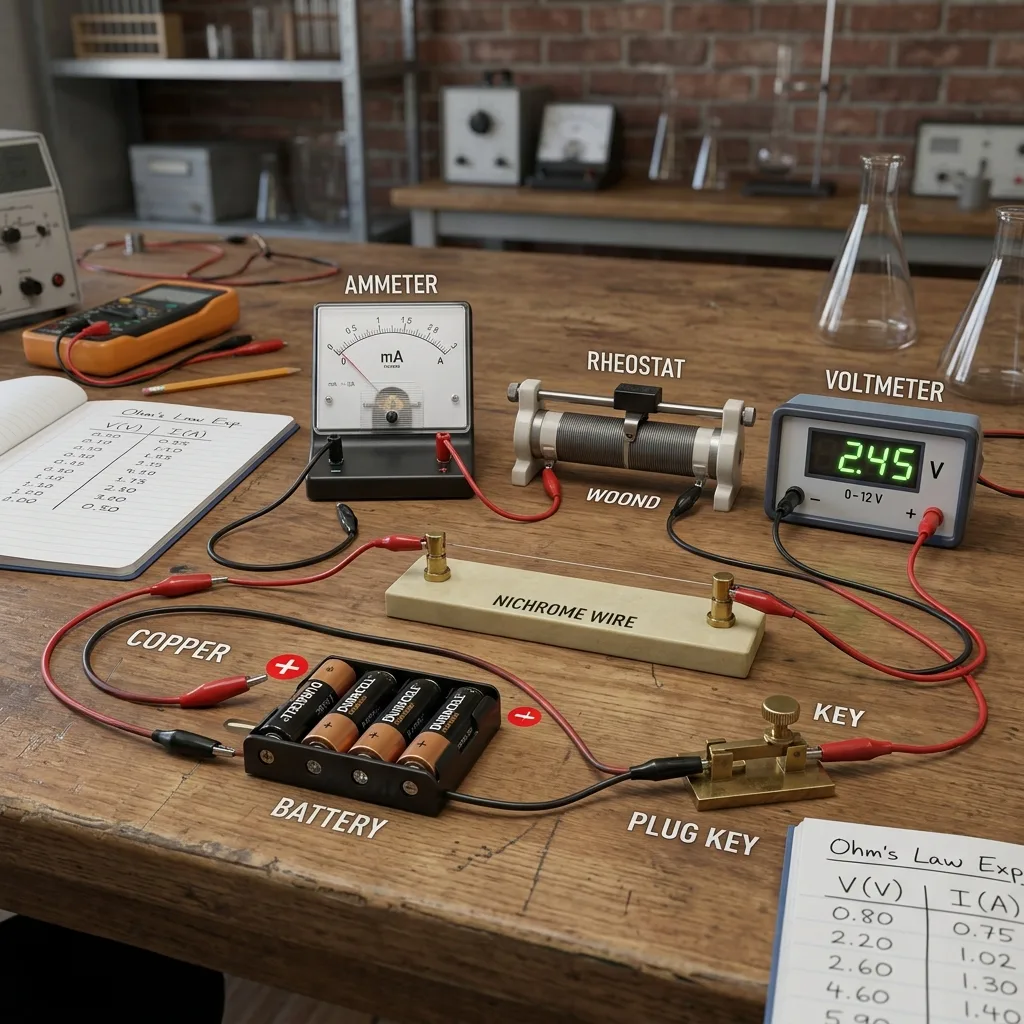
In 1827, a German physicist Georg Simon Ohm found a relationship between the current I flowing in a metallic wire and the potential difference V across its terminals. According to Ohm's Law (Ohm's law), the electric current flowing through a metallic conductor is directly proportional to the potential difference across its ends, provided its temperature remains constant [NCERT p.189]. 1827 में, एक German physicist Georg Simon Ohm ने wire में बहने वाले current I और उसके ends के potential difference V के बीच relation खोजा। Ohm's Law (Ohm's law) के अनुसार, किसी metallic conductor में बहने वाला current उसके ends के cross potential difference के directly proportional होता है, बशर्ते उसका temperature constant रहे [NCERT p.189]।
V ∝ I ⇒ V = I R
where R is a constant for the given metallic wire at a given temperature and is called its resistance (resistance). It is the property of a conductor to resist the flow of charges through it [NCERT p.189]. जहाँ R दिए गए metallic wire के लिए constant है और इसे इसका resistance (resistance) कहते हैं। यह किसी conductor की वह property है जिससे वह अपने अंदर बहने वाले charges के flow का विरोध (resist) करता है [NCERT p.189]।
The SI unit of resistance is the ohm (Ω). According to Ohm's law, R = V / I. If the potential difference across the two ends of a conductor is 1 V and the current through it is 1 A, then the resistance of the conductor is 1 Ω, i.e., 1 Ω = 1 V/A [NCERT p.189]. Also, the current through a resistor is inversely proportional to its resistance (I = V/R) [NCERT p.189]. Resistance का SI unit ohm (Ω) है। Ohm's law के अनुसार, R = V / I। यदि ends के cross potential difference 1 V हो और बहने वाला current 1 A हो, तो conductor का resistance 1 Ω होगा, यानी 1 Ω = 1 V/A [NCERT p.189]। साथ ही, current resistance के inversely proportional होता है (I = V/R) [NCERT p.189]।
V-I Graph: For an ohmic conductor, the graph of potential difference V versus current I is a straight line passing through the origin. The slope of this line represents the resistance of the conductor [NCERT p.189]. V-I Graph: Ohmic conductor के लिए potential difference V और current I का graph origin से pass होने वाली एक straight line होती है। इस line का slope conductor के resistance को represent करता है [NCERT p.189]।
⚡ Checkpoint 3: Ohm's LawCheckpoint 3: ओम का नियम
Section SummarySection Summary (अनुभाग सारांश)
- Ohm's Law: V = IR (at constant temperature).
- Resistance (R): Opposition to current. Unit: Ohm (Ω). 1 Ω = 1 V / 1 A.
- Current: Inversely proportional to resistance. Doubling R halves I.
- V-I Graph: A straight line; steeper slope indicates higher resistance.
Rotate the 3D wire segment by dragging. Adjust the Voltage slider to speed up the drifting electrons (small blue spheres). Increase the Resistance slider to add impurity ions (orange spheres) which cause collisions, vibrating the copper atoms (large purple spheres) and generating heat (glow)! 3D wire segment को drag करके rotate करें। Drifting electrons (छोटे नीले गोले) की speed बढ़ाने के लिए Voltage slider को adjust करें। Impurity ions (नारंगी गोले) जोड़ने के लिए Resistance slider बढ़ाएं, जो collisions (टक्कर) का कारण बनते हैं, जिससे copper atoms (बड़े बैंगनी गोले) vibrate होते हैं और heat (चमक) पैदा होती है!
Drift Current (I = V/R): 0.30 A
Thermal Heat Output (P = I²R): 1.80 W
Lattice Vibrations: Medium
4. Factors on which Resistance Depends (प्रतिरोध को प्रभावित करने वाले कारक)
The resistance of a uniform metallic conductor depends on [NCERT p.190]: एक uniform metallic conductor का resistance इन बातों पर depend करता है [NCERT p.190]:
- its length (l) — directly proportional: R ∝ l इसकी length (l) पर — directly proportional: R ∝ l
- its area of cross-section (A) — inversely proportional: R ∝ 1/A इसके cross-section के area (A) पर — inversely proportional: R ∝ 1/A
- the temperature of the conductor conductor के temperature पर
- the nature of the material conductor के material के nature (प्रकृति) पर
Combining these factors, we get [NCERT p.191]: इन factors को combine करने पर हमें मिलता है [NCERT p.191]:
R = ρ ( l / A )
where ρ (rho) is a constant of proportionality called the electrical resistivity (resistivity) of the material of the conductor. The SI unit of resistivity is the ohm-meter (Ω·m) [NCERT p.191]. जहाँ ρ (rho) proportionality constant है जिसे material की electrical resistivity (resistivity) कहते हैं। Resistivity का SI unit ohm-meter (Ω·m) होता है [NCERT p.191]।
Resistivity is a characteristic property of the material. Metals and alloys have very low resistivity in the range of 10-8 Ω·m to 10-6 Ω·m, making them good conductors. Insulators like rubber and glass have very high resistivity in the range of 1012 to 1017 Ω·m [NCERT p.191]. Resistivity material की एक characteristic property (विशिष्ट गुण) है। Metals और alloys की resistivity बहुत कम (10-8 Ω·m से 10-6 Ω·m) होती है, जो इन्हें good conductors बनाती है। Rubber और glass जैसे insulators की resistivity बहुत high (1012 से 1017 Ω·m) होती है [NCERT p.191]।
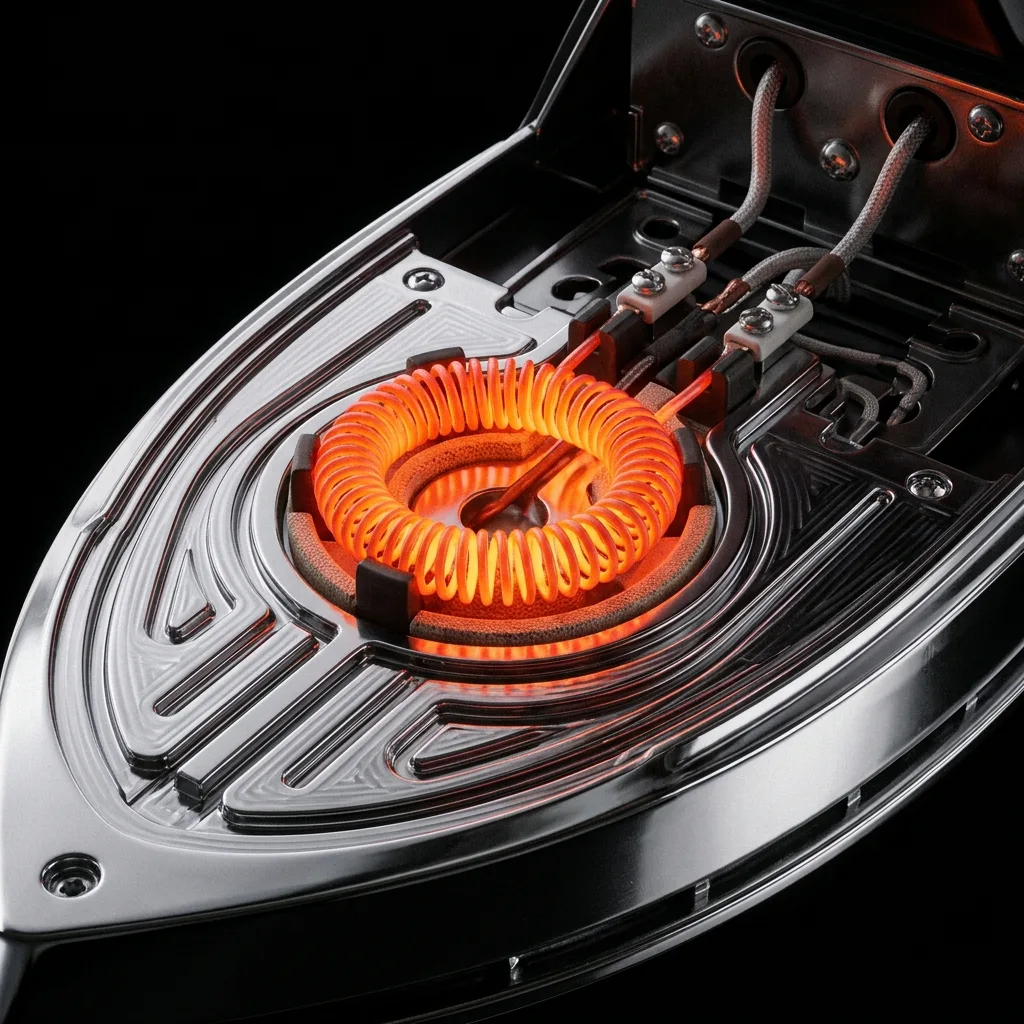
Alloys (like nichrome, manganin, constantan) have higher resistivity than their constituent metals. Alloys do not oxidise (burn) readily at high temperatures, which is why they are commonly used in heating elements of electrical appliances like electric irons, heaters, and toasters [NCERT p.191]. Silver is the best electrical conductor, followed by copper and aluminium. Alloys (जैसे nichrome, manganin, constantan) की resistivity उनके constituent pure metals से अधिक होती है। Alloys high temperature पर आसानी से oxidise (जलते) नहीं हैं, यही कारण है कि इनका उपयोग electric irons, heaters, और toasters जैसे electrical heating appliances के heating elements में किया जाता है [NCERT p.191]। Silver सबसे अच्छा electrical conductor है, जिसके बाद copper और aluminium आते हैं।
⚡ Checkpoint 4: Factors of ResistanceCheckpoint 4: resistance को प्रभावित करने वाले कारक
Section SummarySection Summary (अनुभाग सारांश)
- Formula: R = ρl/A. Resistivity (ρ) depends ONLY on material and temperature. Formula: R = ρl/A. Resistivity (ρ) केवल material के nature और temperature पर depend करती है।
- Length & Area: Long and thin wires have high resistance; short and thick wires have low resistance. Length & Area: लंबे और पतले wires का resistance अधिक होता है; छोटे और मोटे wires का resistance कम होता है।
- Alloys: High resistivity, do not melt/oxidize easily, used in heating appliances. Alloys: High resistivity, आसानी से melt/oxidize नहीं होते, heating appliances में उपयोग होते हैं।
5. Resistance of a System of Resistors (प्रतिरोधकों का संयोजन)
Series CombinationSeries Combination (series combination)
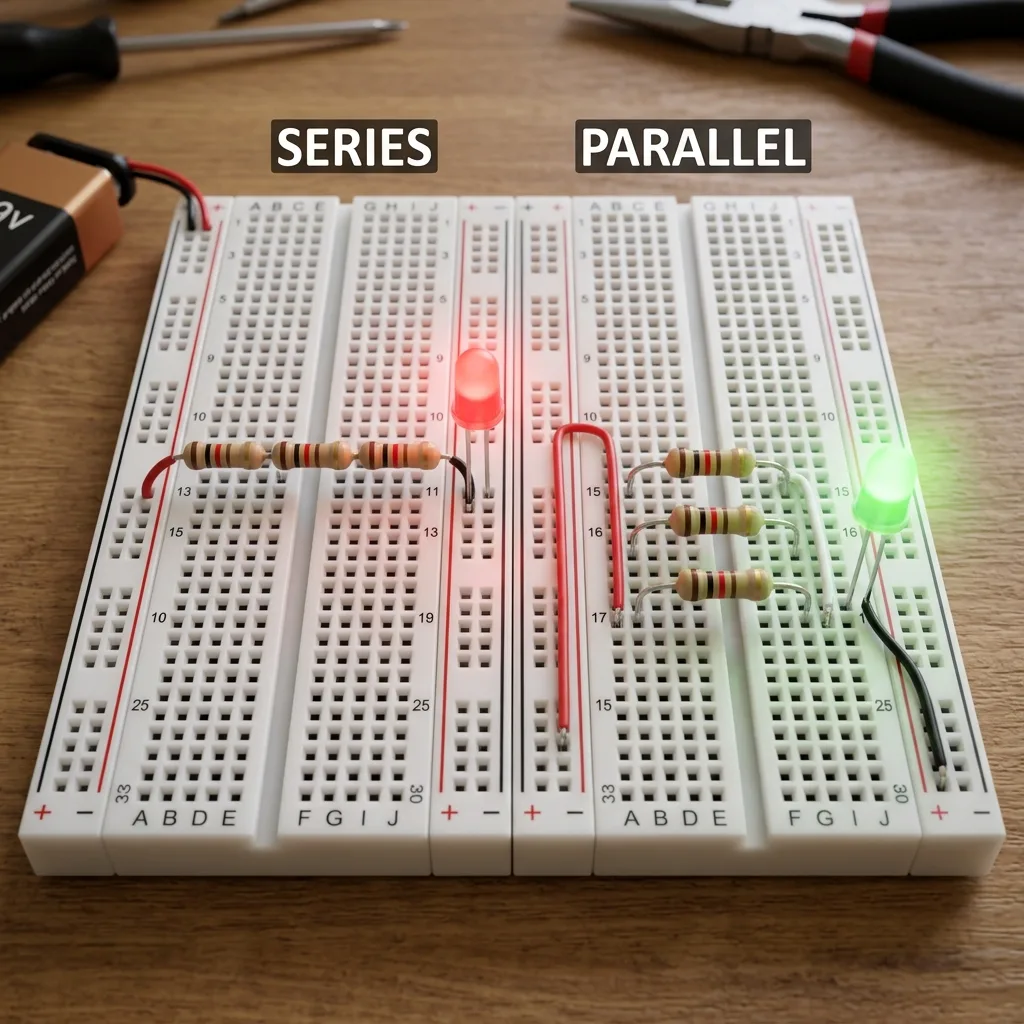
When resistors are joined end-to-end, they are said to be connected in series. In a series circuit [NCERT p.193]: जब resistors को सिरे-से-सिरा (end-to-end) मिलाकर जोड़ा जाता है, तो उन्हें series में connected कहा जाता है। एक series circuit में [NCERT p.193]:
- The current (I) remains the same through all resistors. सभी resistors में से बहने वाला current (I) समान रहता है।
- The total potential difference (V) divides across the resistors: V = V₁ + V₂ + V₃. Total potential difference (V) सभी resistors के cross बंट जाता है: V = V₁ + V₂ + V₃।
- The equivalent resistance is the sum of individual resistances: Equivalent resistance सभी individual resistances का sum होता है:
Rs = R₁ + R₂ + R₃
Parallel CombinationParallel Combination (पार्श्वक्रम combination)
When resistors are connected across the same two nodes, they are in parallel. In a parallel circuit [NCERT p.197]: जब resistors को समान दो points के cross जोड़ा जाता है, तो वे parallel में होते हैं। एक parallel circuit में [NCERT p.197]:
- The potential difference (V) remains the same across all resistors. सभी resistors के cross potential difference (V) समान रहता है।
- The total current (I) divides through the branches: I = I₁ + I₂ + I₃. Total current (I) सभी branches में विभाजित (divide) हो जाता है: I = I₁ + I₂ + I₃।
- The reciprocal of the equivalent resistance is: Equivalent resistance का reciprocal (व्युत्क्रम) होता है:
1 / Rp = 1 / R₁ + 1 / R₂ + 1 / R₃
Domestic Wiring: Why Parallel?Domestic Wiring: Parallel Connection क्यों?
We do not connect domestic appliances in series because [NCERT p.201]: हम घरेलू उपकरणों (domestic appliances) को series में नहीं जोड़ते हैं क्योंकि [NCERT p.201]:
- If one appliance fails or is turned off, the circuit is broken and all other appliances stop working. यदि कोई एक appliance खराब हो जाए या बंद कर दिया जाए, तो circuit टूट जाता है और बाकी सभी appliances काम करना बंद कर देते हैं।
- Each appliance needs a different current (e.g. an AC needs 15 A while a bulb needs 0.1 A), but in series, current is identical. हर appliance को अलग-अलग current चाहिए (जैसे AC को 15 A चाहिए जबकि bulb को 0.1 A), लेकिन series में current identical (एक समान) रहता है।
- In series, the voltage divides, so devices do not get their rated 220 V. In parallel, every device gets the full 220 V. Series में voltage divide हो जाता है, जिससे devices को अपना rated 220 V नहीं मिल पाता। Parallel में, हर device को पूरा 220 V मिलता है।
Students often make a critical algebraic mistake when calculating parallel resistance: forgetting to invert the final fraction! Look at the calculation steps below. Find the step where the mistake was made and click on it. Students parallel resistance calculate करते समय अक्सर एक critical algebraic mistake करते हैं: अंतिम fraction को पलटना (invert करना) भूल जाना! नीचे दिए गए calculation steps को देखें, गलती पहचानें और उस पर click करें।
For two parallel resistors of 3 Ω and 6 Ω:
⚡ Checkpoint 5: Series and Parallel ResistorsCheckpoint 5: series और parallel resistanceक
Section SummarySection Summary (अनुभाग सारांश)
- Series (V divides, I identical): R_total = R₁ + R₂ + R₃. Total resistance increases.
- Parallel (I divides, V identical): 1/R_total = 1/R₁ + 1/R₂ + 1/R₃. Total resistance is smaller than the smallest branch.
- Domestic Parallel: Provides independent switches, identical voltage (220V), and safety from whole-circuit failure.
6. Heating Effect of Electric Current (विद्युत धारा का तापीय प्रभाव)
If the electric circuit is purely resistive, that is, a configuration of resistors practically connected to a battery, the energy source is continuously dissipated entirely in the form of heat. This is known as the heating effect of electric current (heating effect) [NCERT p.202]. यदि कोई electric circuit purely resistive है, यानी उसमें केवल resistors ही battery से जुड़े हैं, तो source की energy लगातार पूरी तरह से heat के रूप में lost होती रहती है। इसे heating effect of electric current (heating effect) कहते हैं [NCERT p.202]।
Consider a current I flowing through a resistor of resistance R. Let the potential difference across it be V. The work done in moving charge Q is V × Q, and the power input is P = V(Q/t) = VI. The energy supplied to the circuit by the source in time t is H = P × t = VIt. Applying Ohm's law (V=IR), we obtain Joule's Law of Heating (Joule's law) [NCERT p.202]: मान लीजिए resistance R वाले resistor से current I बह रहा है और potential difference V है। Charge Q को move करने में किया गया work done V × Q होगा, और input power P = V(Q/t) = VI होगी। Source द्वारा समय t में supplied energy H = P × t = VIt होगी। Ohm's law (V=IR) apply करने पर हमें Joule's Law of Heating (Joule's law) प्राप्त होता है [NCERT p.202]:
H = I2 R t
This law implies that heat produced in a resistor is [NCERT p.202]: इस नियम के अनुसार, किसी resistor में produced heat [NCERT p.202]:
- directly proportional to the square of current for a given resistance, दिए गए resistance के लिए current के square के directly proportional होती है,
- directly proportional to resistance for a given current, and दिए गए current के लिए resistance के directly proportional होती है, और
- directly proportional to the time for which the current flows. उस समय (time) के directly proportional होती है जिसके लिए current बहता है।
Practical Applications:व्यावहारिक अनुप्रयोग (Practical Applications):
- Heating Appliances: Electric iron, toaster, oven, kettle, heater rely on high-resistance elements (like nichrome) to convert current to heat. Heating Appliances: Electric iron, toaster, oven, kettle, heater आदि high-resistance elements (जैसे nichrome) पर rely करते हैं ताकि वे current को heat में बदल सकें।
- Electric Bulb: The filament is made of tungsten because it has a very high melting point (3380 °C) and does not melt when glowing white-hot. Bulbs are filled with chemically inactive nitrogen or argon to prevent oxidation [NCERT p.202]. Electric Bulb: इसका filament tungsten का बना होता है क्योंकि इसका melting point (गलनांक) बहुत high (3380 °C) होता है और यह सफेद-गर्म (white-hot) होने पर भी पिघलता नहीं है। Bulbs को chemically inactive nitrogen या argon गैसों से भरा जाता है ताकि filament का oxidation न हो [NCERT p.202]।
- Electric Fuse: A safety device connected in series with the live wire. It consists of a wire made of a metal/alloy with a low melting point (e.g. tin-lead alloy). If the current exceeds a safe limit (due to overloading or short-circuiting), the fuse wire melts and breaks the circuit, protecting appliances [NCERT p.202]. Electric Fuse: यह live wire के साथ series में जुड़ा एक safety device है। इसमें कम melting point वाले metal/alloy (जैसे tin-lead alloy) का wire होता है। यदि overloading या short-circuit के कारण current सुरक्षित सीमा से अधिक हो जाता है, तो fuse wire पिघलकर circuit को break कर देता है, जिससे appliances सुरक्षित रहते हैं [NCERT p.202]।
⚡ Checkpoint 6: Heating EffectCheckpoint 6: electric current का तापीय प्रभाव
Section SummarySection Summary (अनुभाग सारांश)
- Joule's Law (H = I²Rt): Energy converted to heat in a resistor.
- Bulb: Uses high melting point Tungsten filament and inert gases.
- Fuse: Safety device with a low melting point wire; connected in series with the live wire.
7. Electric Power (विद्युत शक्ति)
We know that the rate of doing work is power. This is also the rate of consumption of energy. The electric power (P) is the rate at which electrical energy is dissipated or consumed in an electric circuit [NCERT p.205]: हम जानते हैं कि work done करने का rate power है। यह energy consumption का rate भी है। किसी electric circuit में electrical energy के consume या dissipate होने की rate को electric power (P) कहा जाता है [NCERT p.205]:
P = V I = I2 R = V2 / R
The SI unit of electric power is the watt (W). It is the power consumed by a device that carries 1 A of current when operated at a potential difference of 1 V, i.e., 1 W = 1 V × 1 A [NCERT p.205]. Since W is small, we use kilowatt (1 kW = 1000 W). Electric power का SI unit watt (W) है। यह उस device द्वारा consumed power है जो 1 V potential difference पर 1 A current लेता है, यानी 1 W = 1 V × 1 A [NCERT p.205]। चूंकि watt एक छोटा unit है, इसलिए हम kilowatt (1 kW = 1000 W) का उपयोग करते हैं।
Commercial Unit of Electrical Energy: The product of power and time gives electrical energy. The SI unit of electrical energy is the Joule (J). However, the commercial unit of electrical energy is the kilowatt-hour (kWh), commonly known as a 'unit' of electricity [NCERT p.206]. Commercial Unit of Electrical Energy: power और time का product (गुणनफल) electrical energy देता है। Electrical energy का SI unit Joule (J) है। लेकिन electrical energy का commercial unit kilowatt-hour (kWh) है, जिसे आमतौर पर बिजली का 'unit' (यूनिट) कहा जाता है [NCERT p.206]।
1 kWh = 1 kW × 1 hour = 1000 W × 3600 s = 3.6 × 10⁶ Joules (J)
Interactive Load Visualizerलोड विज़ुअलाइज़र (Interactive Load Visualizer)
See how high wattage appliances drastically increase your energy bill compared to low power bulbs. देखें कि कैसे high wattage वाले उपकरण low power bulbs की तुलना में आपके बिजली के बिल को तेजी से बढ़ाते हैं।
⚡ Checkpoint 7: Electric PowerCheckpoint 7: electric शक्ति
Section SummarySection Summary (अनुभाग सारांश)
- Power (P = VI = I²R = V²/R): Rate of electrical energy consumption. Unit: Watt (W).
- Commercial Energy Unit: Kilowatt-hour (kWh) or 'Unit'.
- Conversion: 1 kWh = 3.6 × 10⁶ J.
- Cost: Total units (kWh) × cost per unit.
NCERT Solutions
In-Text Questions (पाठ्यपुस्तक के प्रश्न)
1 A = 1 C / 1 s
Let n be the number of electrons constituting a charge Q = 1 C.
Using the quantization of charge:
Q = n × e
n = Q / e = 1 C / (1.6 × 10⁻¹⁹ C)
n = 6.25 × 10¹⁸ electrons.
1 V = 1 J / 1 C
The potential difference is defined as W/Q, where W is the work done (which is equal to the energy given).
Therefore, Energy W = V × Q = 6 V × 1 C = 6 Joules (J).
- Length of the conductor (l): R is directly proportional to length (R ∝ l).
- Area of cross-section (A): R is inversely proportional to cross-sectional area (R ∝ 1/A).
- Nature of the material: Different materials have different electrical resistivities (ρ).
- Temperature: For metallic conductors, resistance increases with temperature.
Reason: The resistance (R) of a wire is inversely proportional to its cross-sectional area (R ∝ 1/A). A thick wire has a larger cross-sectional area, meaning it has lower resistance than a thin wire of the same material and length. Since current I = V/R, for the same voltage source, lower resistance allows more current to flow.
- Alloys have much higher electrical resistivity than pure metals, generating more heat.
- Alloys do not readily oxidise (burn) or melt at high operating temperatures.
Exercise Questions (अध्याय के अभ्यास प्रश्न)
Explanation: When the wire is cut into 5 equal parts, the resistance of each part becomes R/5 (since resistance is directly proportional to length).
When these 5 parts are connected in parallel, the equivalent resistance R' is:
1/R' = 1/(R/5) + 1/(R/5) + 1/(R/5) + 1/(R/5) + 1/(R/5)
1/R' = 5/R + 5/R + 5/R + 5/R + 5/R = 25/R
⇒ R' = R / 25
⇒ Ratio R / R' = 25.
Explanation: Power P is given by VI. Using Ohm's law V = IR, we get P = I²R. Alternatively, using I = V/R, we get P = V²/R. Thus, IR² is not a valid expression for electrical power.
Explanation:
Step 1: Calculate the resistance of the bulb.
P = V² / R ⇒ R = V² / P = (220)2 / 100 = 48400 / 100 = 484 Ω.
Step 2: Calculate power consumed at 110 V.
P_new = V_new2 / R = (110)2 / 484 = 12100 / 484 = 25 W.
Explanation: Let the resistance of each wire be R.
1. Series: R_s = R + R = 2R.
Heat produced H_s = V²t / R_s = V²t / 2R.
2. Parallel: 1/R_p = 1/R + 1/R = 2/R ⇒ R_p = R/2.
Heat produced H_p = V²t / R_p = V²t / (R/2) = 2V²t / R.
3. Ratio: H_s / H_p = (V²t / 2R) / (2V²t / R) = 1/4 or 1:4.
Solved CBSE Previous Year Questions (PYQs)
The V-I graph for an ohmic conductor is a straight line passing through the origin. The slope of the V-I graph (V/I) represents the electrical resistance (R) of the conductor. Ohmic conductor के लिए V-I graph origin से pass होने वाली एक straight line होती है। V-I graph का slope (V/I) conductor के electrical resistance (R) को represent करता है।
Among silver, copper, and constantan, constantan (an alloy) has the highest electrical resistivity. Utility: It is used in making standard resistors and heating elements because its resistance is stable and doesn't change easily with temperature. Silver, copper, और constantan में से constantan (एक alloy) की resistivity सबसे अधिक होती है। Utility: इसका उपयोग standard resistors और heating elements बनाने में किया जाता है क्योंकि इसका resistance temperature के साथ आसानी से नहीं बदलता।
The diameter divides the circular wire into two equal semicircular halves. The resistance of each half is R₁ = R₂ = 20 / 2 = 10 Ω. Since these two halves are in parallel, 1/R_eq = 1/10 + 1/10 = 2/10 = 1/5 ⇒ R_eq = 5 Ω. Diameter circle को दो equal semicircular halves में बांटता है। हर आधे भाग का resistance R₁ = R₂ = 20 / 2 = 10 Ω होगा। चूँकि ये दोनों parallel में जुड़े हैं, 1/R_eq = 1/10 + 1/10 = 2/10 = 1/5 ⇒ R_eq = 5 Ω.
(a) Joule's Law states that heat produced in a resistor is directly proportional to the square of current (I²), resistance (R), and time (t): H = I²Rt.
(b) Given: P = 1000 W = 1 kW, V = 220 V, t = 2 h.
(i) Current I = P / V = 1000 / 220 = 4.55 A.
(ii) Resistance R = V / I = 220 / 4.55 = 48.4 Ω.
(iii) Energy E = P × t = 1 kW × 2 h = 2 kWh. (a) Joule's Law के अनुसार, किसी resistor में produced heat current के square (I²), resistance (R), और time (t) के directly proportional होती है: H = I²Rt.
(b) Given: P = 1000 W = 1 kW, V = 220 V, t = 2 h.
(i) Current I = P / V = 1000 / 220 = 4.55 A.
(ii) Resistance R = V / I = 220 / 4.55 = 48.4 Ω.
(iii) Energy E = P × t = 1 kW × 2 h = 2 kWh.
Alloys are used because: (1) They have higher electrical resistivity than their constituent pure metals. (2) They do not oxidise (burn) or melt easily at high temperatures. Alloys का उपयोग इसलिए किया जाता है क्योंकि: (1) इनकी electrical resistivity इनकी pure metals की तुलना में अधिक होती है। (2) ये high temperatures पर आसानी से oxidise (जलते) या melt नहीं होते।
Given: Charge Q = 1 C, Charge of one electron e = 1.6 × 10⁻¹⁹ C. Using Q = ne ⇒ n = Q/e = 1 / (1.6 × 10⁻¹⁹) = 6.25 × 10¹⁸ electrons. Given: Charge Q = 1 C, एक electron का charge e = 1.6 × 10⁻¹⁹ C. Q = ne का उपयोग करके ⇒ n = Q/e = 1 / (1.6 × 10⁻¹⁹) = 6.25 × 10¹⁸ electrons.
Resistance (R) is represented by the slope of the V-I graph (V/I). Since resistor A makes a larger angle (steeper slope) with the current axis (x-axis), it has a higher V/I ratio for any given current. Thus, resistor A has a higher resistance than resistor B. V-I graph का slope (V/I) resistance (R) को दर्शाता है। चूँकि resistor A, current axis (x-axis) के साथ बड़ा angle बनाता है, इसलिए किसी दिए गए current के लिए इसका V/I ratio अधिक है। अतः resistor A का resistance, B से अधिक है।
Resistance of the bulb: R = V² / P = (220)² / 100 = 484 Ω.
When operated on V' = 110 V, new power consumed P' = V'² / R = (110)² / 484 = 12100 / 484 = 25 W. Bulb का resistance: R = V² / P = (220)² / 100 = 484 Ω.
जब V' = 110 V पर operate किया जाता है, तो new power P' = V'² / R = (110)² / 484 = 12100 / 484 = 25 W.
Let three resistors R₁, R₂, and R₃ be connected in parallel across a potential difference V.
1. The potential difference V across each resistor is the same.
2. The total current I is the sum of currents in branches: I = I₁ + I₂ + I₃.
3. By Ohm's law: I₁ = V/R₁, I₂ = V/R₂, I₃ = V/R₃, and total current I = V/R_p.
Substituting these: V/R_p = V/R₁ + V/R₂ + V/R₃ ⇒ 1/R_p = 1/R₁ + 1/R₂ + 1/R₃. मान लीजिए R₁, R₂, और R₃ parallel में potential difference V के साथ जुड़े हैं।
1. हर resistor के cross potential difference V समान रहता है।
2. Total current I सभी branches के currents का sum होता है: I = I₁ + I₂ + I₃.
3. Ohm's law के अनुसार: I₁ = V/R₁, I₂ = V/R₂, I₃ = V/R₃, और total current I = V/R_p.
इन्हें substitute करने पर: V/R_p = V/R₁ + V/R₂ + V/R₃ ⇒ 1/R_p = 1/R₁ + 1/R₂ + 1/R₃.
(a) Series is not used because: (1) If one device fails, the circuit breaks and all devices turn off. (2) Different devices need different currents, which is impossible in series. (3) Devices don't get the full 220 V.
(b) Parallel resistance of lamp, toaster, filter:
1/R_p = 1/100 + 1/50 + 1/500 = (5 + 10 + 1) / 500 = 16 / 500
R_p = 500 / 16 = 31.25 Ω.
The electric iron takes as much current as all three, so its resistance is equal to the equivalent resistance: R_iron = 31.25 Ω.
Current through it: I = V / R_iron = 220 / 31.25 = 7.04 A. (a) Series का उपयोग इसलिए नहीं किया जाता क्योंकि: (1) यदि एक device खराब हो जाए, तो circuit टूट जाता है और सभी बंद हो जाते हैं। (2) अलग-अलग devices को अलग current चाहिए, जो series में मुमकिन नहीं। (3) Devices को पूरा 220 V नहीं मिलता।
(b) Lamp, toaster, और filter का parallel resistance:
1/R_p = 1/100 + 1/50 + 1/500 = (5 + 10 + 1) / 500 = 16 / 500
R_p = 500 / 16 = 31.25 Ω.
Electric iron इन तीनों के बराबर current लेता है, इसलिए इसका resistance equivalent resistance के बराबर होगा: R_iron = 31.25 Ω।
इसमें से बहने वाला current: I = V / R_iron = 220 / 31.25 = 7.04 A।
- NCERT Class 10 Science, Chapter 11: Electricity, pp. 186–215. (Reprint 2026-27).
- CBSE Class 10 Science Syllabus & Board Exam Paper Guidelines (2025-26).