Chapter 12: Magnetic Effects of Electric Current
Discover the profound connection between electricity and magnetism. Study magnetic fields, electromagnets, electric motors, generators, electromagnetic induction, and safety in domestic electrical circuits. Electricity और magnetism के बीच के गहरे connection को समझें। Magnetic fields, electromagnets, electric motors, generators, electromagnetic induction, और domestic electrical circuits में safety (सुरक्षा) के बारे में सीखें।
💡 Remember from before:
- In Chapter 11, we learned that electric current is the flow of electric charges through a conductor. Chapter 11 में, हमने सीखा था कि electric current किसी conductor से बहने वाले electric charges का flow होता है।
- A current-carrying conductor dissipates energy in the form of heat (Joule heating). एक current-carrying conductor heat के रूप में energy dissipate (नष्ट/उत्सर्जित) करता है (Joule heating)।
- Electric current also produces magnetic fields, which we explore in this chapter. Electric current magnetic fields भी produce करता है, जिसे हम इस chapter में explore करेंगे।
1. Magnetic Field and Field Lines (चुंबकीय क्षेत्र और क्षेत्र रेखाएँ)
We are familiar with the fact that a compass needle gets deflected when brought near a bar magnet. A compass needle is, in fact, a small bar magnet. The ends of the compass needle point approximately towards north and south directions. The end pointing towards north is called North-seeking (or North pole) and the other end is South-seeking (or South pole) [NCERT p.216].
A magnetic field (magnetic field) is a region around a magnet where its magnetic force can be experienced by other magnets or magnetic materials. It is a vector quantity, having both magnitude and direction [NCERT p.217].
Magnetic field lines (magnetic field lines) are imaginary curves representing the magnetic field. They have the following properties [NCERT p.217]: Magnetic field lines (magnetic field lines) काल्पनिक curves (इमेजिनरी वक्र) हैं जो magnetic field को represent करती हैं। इनके निम्नलिखित properties (गुण) होते हैं [NCERT p.217]:
- They emerge from the North pole and merge at the South pole outside the magnet.
- Inside the magnet, they travel from the South pole to the North pole (forming closed continuous loops).
- The relative strength of the magnetic field is shown by the degree of closeness of the field lines; lines are crowded near the poles where the field is strongest.
- No two field lines cross each other. If they did, it would mean that at the point of intersection, the compass needle would point in two different directions, which is physically impossible.
⚡ Checkpoint 1: Magnetic Field & LinesCheckpoint 1: magnetic field और रेखाएं
Section SummarySection Summary (अनुभाग सारांश)
- Magnetic Field: Region of magnetic influence; has both magnitude and direction (vector). Magnetic Field: Magnetic influence का region; इसके पास magnitude और direction दोनों होते हैं (vector)।
- Loops: Field lines go North to South (outside) and South to North (inside). Loops: Field lines बाहर North से South और अंदर South से North जाती हैं (closed loops)।
- No Intersection: Field lines never intersect because the field vector is unique at every point. No Intersection: Field lines कभी intersect नहीं करतीं क्योंकि हर point पर field vector unique होता है।
2. Magnetic Fields of Various Conductors: Straight Wire, Loop, and Solenoid (विद्युत धारावाही चालकों के कारण चुंबकीय क्षेत्र)
In 1820, Hans Christian Oersted accidentally discovered that a compass needle was deflected when placed near a wire carrying an electric current. This showed that electricity and magnetism are linked [NCERT p.218].
The magnetic field lines around a straight current-carrying conductor form concentric circles centered on the wire. The direction of these magnetic field lines is given by the Right-Hand Thumb Rule (Right-Hand Thumb Rule) [NCERT p.219]:
Imagine that you are holding a current-carrying straight conductor in your right hand such that your thumb points in the direction of current. Then your fingers will wrap around the conductor in the direction of the field lines of the magnetic field.
The strength of the magnetic field produced at a point is [NCERT p.219]:
- directly proportional to the current (I) passing through the wire (stronger current = stronger field).
- inversely proportional to the distance (r) from the wire (farther away = weaker field).
Move your mouse inside the visualizer to trace compass needle orientation!
Magnetic Field due to a Circular Loopवृत्ताकार पाश के कारण magnetic field
If a straight wire is bent in the form of a circular loop and current is passed, the magnetic field lines form concentric circles around every section of the wire. As we move away from the wire, the concentric circles representing the field lines become larger and larger, appearing as straight lines at the centre of the loop [NCERT p.220].
Every part of the circular wire contributes to the magnetic field lines in the same direction within the loop. The strength of the magnetic field at the centre of the loop is directly proportional to the current (I), inversely proportional to the radius of the loop, and directly proportional to the number of turns (n) in the coil [NCERT p.221].
Magnetic Field in a Solenoid & Electromagnetsसोलिनाइड और electric चुंबक के कारण magnetic field
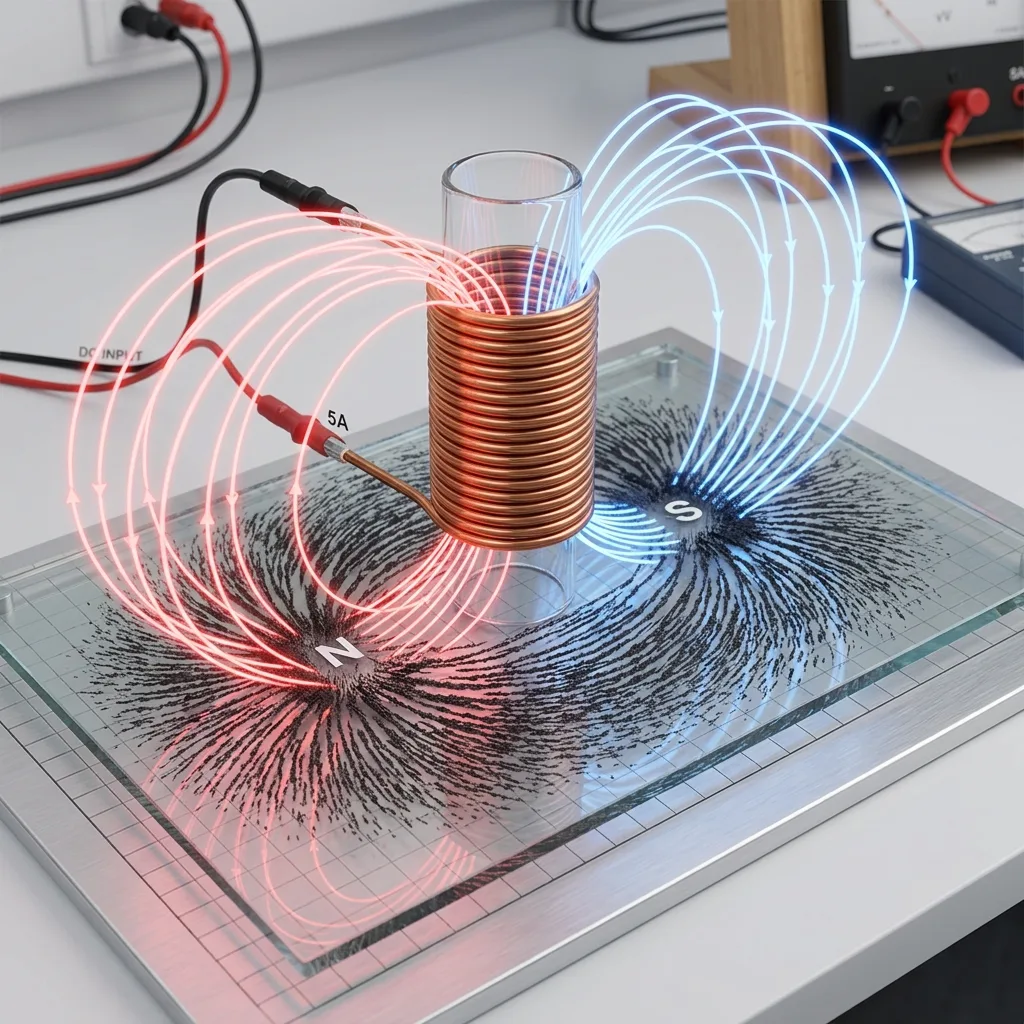
A coil of many circular turns of insulated copper wire wrapped closely in the shape of a cylinder is called a solenoid (solenoid) [NCERT p.221]. पास-पास लिपटे electricरोधी तांबे के तार की बेलन की आकृति की अनेक फेरों वाली कुंडली को solenoid (solenoid) (परिनालिका) कहते हैं [NCERT p.221]।
The magnetic field pattern of a solenoid is identical to that of a bar magnet. The field lines inside the solenoid are in the form of parallel straight lines, which indicates that the magnetic field is uniform inside the solenoid [NCERT p.221].
An electromagnet (electromagnet) is formed by placing a soft iron core inside a solenoid. The strong magnetic field inside the solenoid magnetises the iron core temporarily [NCERT p.222]. Solenoid के अंदर soft iron core रखने से एक electromagnet (electromagnet) (electric चुंबक) बनता है। Solenoid के अंदर का strong magnetic field इस iron core को temporarily magnetise कर देता है [NCERT p.222]।
| Electromagnet (विद्युत चुंबक) | Permanent Magnet (स्थायी चुंबक) |
|---|---|
| Temporary; magnetism can be switched ON/OFF. | Permanent; cannot be easily demagnetised. |
| Strength can be varied (by changing current/turns). | Strength is fixed. |
| Polarity can be reversed (by changing current direction). | Polarity is fixed. |
| Made of soft iron core. | Made of steel or alloys (like Alnico). |
⚡ Checkpoint 2: Fields of ConductorsCheckpoint 2: चालकों के magnetic field
Section SummarySection Summary (अनुभाग सारांश)
- Straight Wire: Concentric circles centered on the wire. Field strength I/r.
- Circular Loop: Fields add up at the centre to form straight lines. Field strength proportional to turns (n).
- Solenoid: Resembles a bar magnet with a uniform internal field. Soft iron core makes it an electromagnet.
3. Force and Fleming's Left-Hand Rule (बल और फ्लेमिंग का वामहस्त नियम)
French scientist André-Marie Ampère suggested that if a current-carrying conductor produces a magnetic field and exerts a force on a magnet, the magnet must also exert an equal and opposite force on the current-carrying conductor [NCERT p.222].
The displacement of the conductor is maximum when the direction of the current is at right angles (90°) to the direction of the magnetic field. The force is zero when the wire is parallel to the field lines [NCERT p.223].
The direction of this force is given by Fleming's Left-Hand Rule (Fleming's Left-Hand Rule) [NCERT p.223]: इस force की direction Fleming's Left-Hand Rule (Fleming's Left-Hand Rule) (फ्लेमिंग का वामहस्त नियम) द्वारा दी जाती है [NCERT p.223]:
Stretch the thumb, forefinger and middle finger of your left hand such that they are mutually perpendicular to each other. If the first finger points in the direction of magnetic Field, the second finger points in the direction of Current, then the thumb will point in the direction of Motion (Force).
⚡ Checkpoint 3: Force & Left-Hand RuleCheckpoint 3: बल और वामहस्त नियम
Section SummarySection Summary (अनुभाग सारांश)
- Force: A current-carrying conductor experiences force in a magnetic field; maximum when perpendicular (90°). Force: Magnetic field में current-carrying conductor force experience करता है; perpendicular (90°) होने पर maximum होता है।
- Fleming's Left-Hand Rule: Thumb = Motion (Force), Forefinger = Field, Middle Finger = Current (remember: L-F-C = Left-Field-Current). Fleming's Left-Hand Rule: Thumb = Motion (Force), Forefinger = Field, Middle Finger = Current (याद रखें: L-F-C = Left-Field-Current)।
4. Electric Motor (विद्युत मोटर)
An electric motor (electric motor) is a rotating device that converts electrical energy into mechanical energy [NCERT p.225]. It is used in fans, washing machines, refrigerators, mixers, and electric cars.
Principle: When a rectangular coil is placed in a magnetic field and current is passed through it, the coil experiences mutually perpendicular forces (Fleming's left-hand rule) that rotate it continuously [NCERT p.225]. Principle: जब किसी rectangular coil को magnetic field में रखकर current पास किया जाता है, तो coil mutually perpendicular forces (Fleming's left-hand rule के अनुसार) अनुभव करती है जो इसे continuously rotate करते हैं [NCERT p.225]।
Key Components:
- Armature Coil (ABCD): A rectangular loop of insulated copper wire [NCERT p.225].
- Split Ring Commutator (P & Q): A metallic ring split into two halves. It reverses the direction of current in the coil every half-rotation, ensuring continuous rotation in one direction [NCERT p.225].
- Brushes (X & Y): Stationary carbon blocks that touch the rotating split rings, maintaining electrical contact with the battery [NCERT p.225].
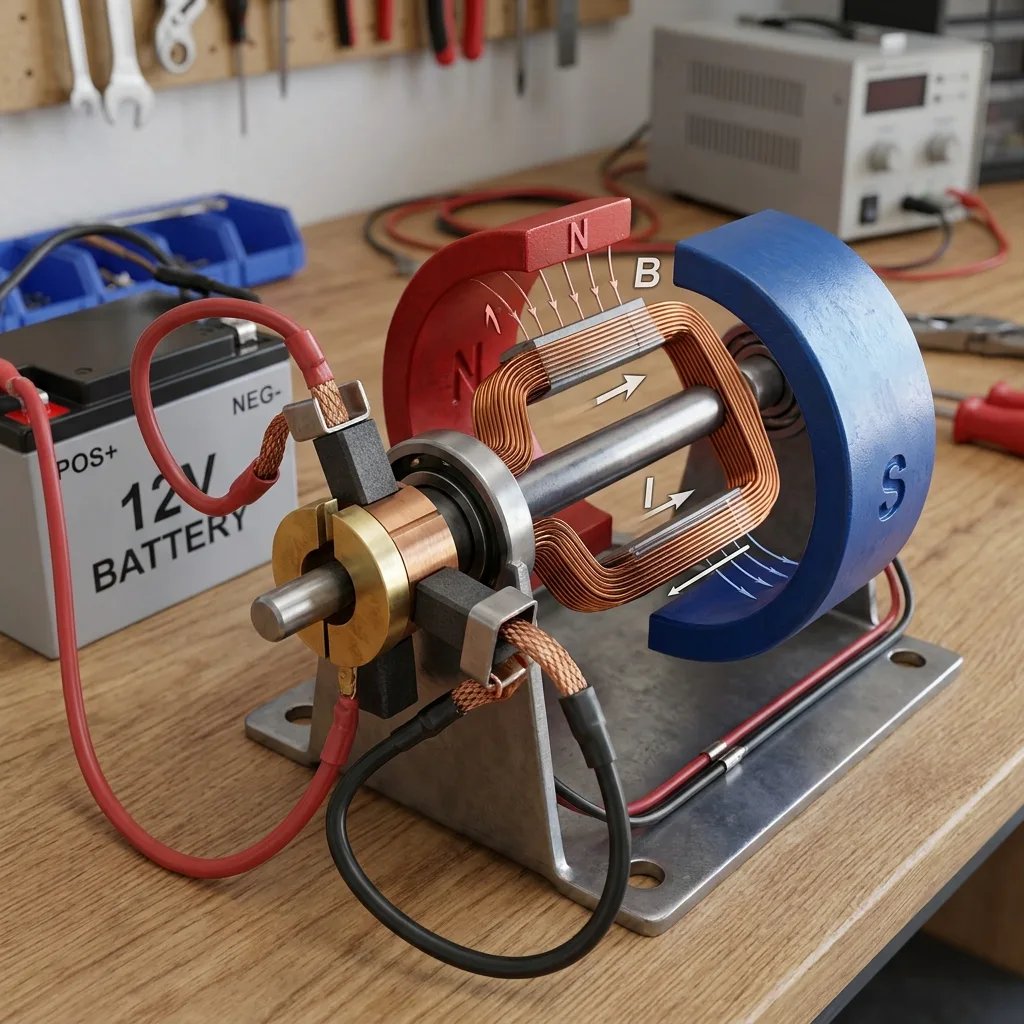
Rotate the 3D motor view by dragging. Click "Power On" to run current, which rotates the loop. Inspect the commutator split-rings and brushes, and toggle the electromagnetic force vector arrows (Fleming's Left-Hand Rule)!
■ Magnetic Field (B): N to S (Green)
■ Current (I): Along loop (Yellow)
■ Force (F): Fleming's rule (Magenta)
⚡ Checkpoint 4: Electric MotorCheckpoint 4: electric मोटर
Section SummarySection Summary (अनुभाग सारांश)
- Energy Shift: Converts electrical energy to mechanical energy. Energy Shift: Electrical energy को mechanical energy में convert करता है।
- Commutator: Split-rings rotate with the coil and reverse current every 180° to sustain rotation. Commutator: Split-rings coil के साथ घूमते हैं और rotation बनाए रखने के लिए हर 180° पर current reverse करते हैं।
- Brushes: Stationary carbon contacts feeding current to the commutator. Brushes: Commutator को current feed करने वाले stationary carbon contacts.
5. Electromagnetic Induction and Generators (विद्युत चुंबकीय प्रेरण और जनरेटर)
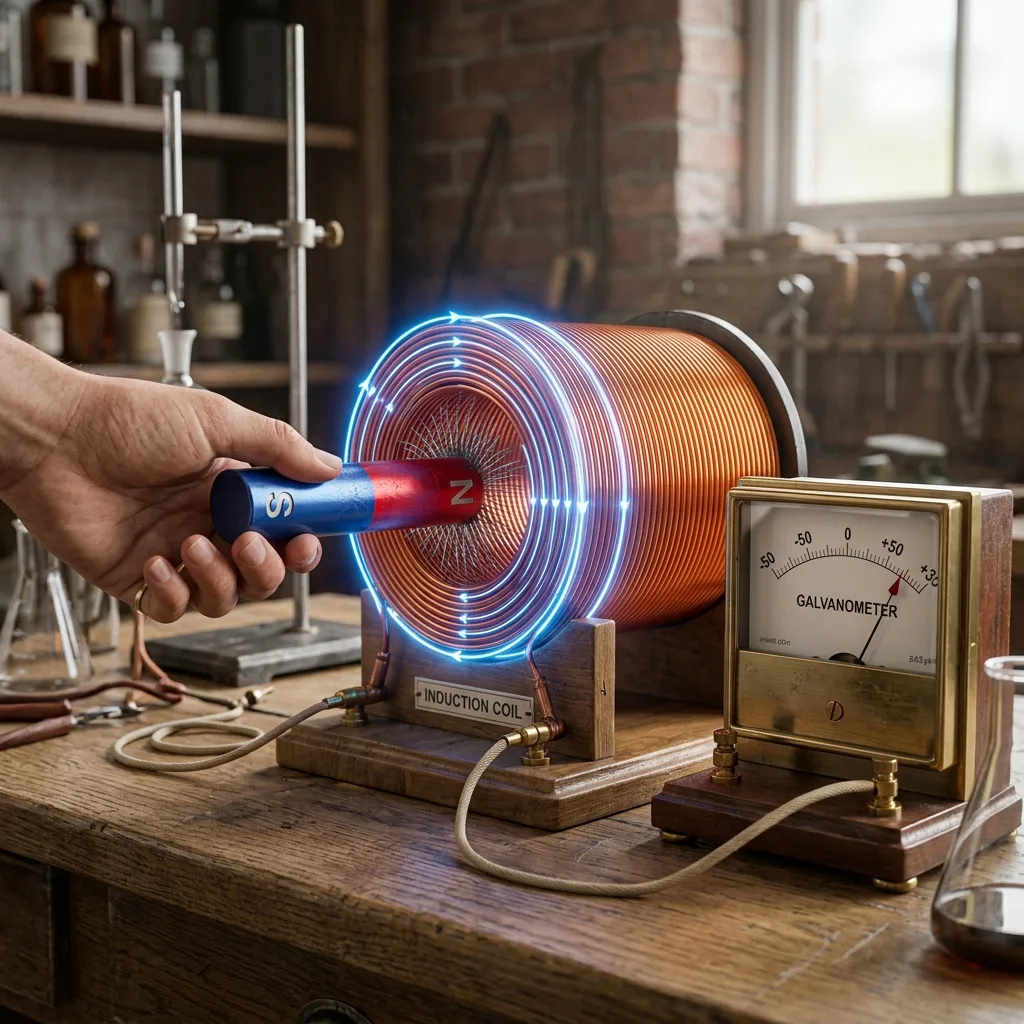
In 1831, Michael Faraday discovered that a changing magnetic field inside a loop of wire induces an electric current in it. This phenomenon is called electromagnetic induction (electromagnetic induction) [NCERT p.227]. 1831 में, Michael Faraday ने खोजा कि wire की loop के अंदर बदलता हुआ magnetic field उसमें electric current induce करता है। इस phenomenon (घटना) को electromagnetic induction (electromagnetic induction) कहते हैं [NCERT p.227]।
Faraday's Observations:
- When a bar magnet is pushed rapidly into a coil of wire connected to a galvanometer, the galvanometer needle deflects momentarily, indicating that current is induced [NCERT p.227].
- When the magnet is held stationary, the deflection is zero [NCERT p.227].
- When the magnet is pulled out, the needle deflects in the opposite direction [NCERT p.227].
Lenz's Law (लेंज का नियम): Lenz's law states that the induced current always flows in a direction that opposes the change that created it. If you push a North pole of a magnet into a coil, the coil's face will turn into a North pole (repelling the incoming magnet). If you pull the North pole out, the coil's face will turn into a South pole (attraction to pull it back). Let's test this with a visual challenge! Lenz's Law (लेंज का नियम): Lenz's law के अनुसार induced current हमेशा उस direction में बहता है जो उसे create करने वाले बदलाव का विरोध (oppose) कर सके। यदि आप magnet के North pole को coil के अंदर धकेलेंगे, तो coil का face North pole बन जाएगा (आने वाले magnet को repel करने के लिए)। यदि आप North pole को बाहर खींचेंगे, तो coil का face South pole बन जाएगा (आकर्षण द्वारा उसे वापस खींचने के लिए)। आइए इसे एक visual challenge से test करें!
⚡ Lenz's Law Interactive Checkpoint
You are pushing the North pole of a bar magnet into a copper coil. What is the direction of the induced current when viewed from the side of the magnet entering the coil?
The direction of the induced current is given by Fleming's Right-Hand Rule (Fleming's Right-Hand Rule) [NCERT p.229]: Induced current की direction Fleming's Right-Hand Rule (Fleming's Right-Hand Rule) (फ्लेमिंग का दक्षिण-हस्त नियम) द्वारा दी जाती है [NCERT p.229]:
Stretch the thumb, forefinger and middle finger of your right hand perpendicular to each other. If the forefinger points in the direction of magnetic Field, the thumb points in the direction of Motion of conductor, then the middle finger will point in the direction of induced Current.
Electric Generatorelectric जनरेटर
An electric generator converts mechanical energy into electrical energy using electromagnetic induction. When a coil is rotated mechanically in a magnetic field, a potential difference is induced across its ends, driving a current [NCERT p.230].
- AC Generator (Alternating Current (प्रत्यावर्ती धारा)): Uses slip rings (full circular rings) that maintain contact with carbon brushes. The induced current changes its direction every half rotation, creating Alternating Current (AC) [NCERT p.230].
- DC Generator (Direct Current (दिष्ट धारा)): Uses a split-ring commutator to ensure that the current flows in only one direction in the external circuit, producing Direct Current (DC) [NCERT p.231].
Power Standards in India: In India, the electricity supplied for domestic use is Alternating Current (AC) with a potential difference of 220 V and a frequency of 50 Hz. This means the current changes its direction 100 times per second (every 1/100 s) [NCERT p.231].
⚡ Checkpoint 5: Electromagnetic InductionCheckpoint 5: electric magnetic induction
Section SummarySection Summary (अनुभाग सारांश)
- Electromagnetic Induction: Changing magnetic flux inside a coil induces an EMF/current. Electromagnetic Induction: Coil के अंदर बदलते magnetic flux से EMF/current induce होता है।
- Fleming's Right-Hand Rule: Thumb = Motion, Forefinger = Field, Middle Finger = Induced Current (R-F-C: Right-Field-Current). Fleming's Right-Hand Rule: Thumb = Motion, Forefinger = Field, Middle Finger = Induced Current (R-F-C: Right-Field-Current)।
- AC vs. DC Generator: AC uses slip-rings (reversing current); DC uses split-ring commutators (unidirectional current). AC vs. DC Generator: AC slip-rings का उपयोग करता है (reversing current); DC split-ring commutators का उपयोग करता है (unidirectional current)।
- AC Standard in India: 220V, 50 Hz. Direction reverses every 1/100 s. AC Standard in India: 220V, 50 Hz। Current की direction हर 1/100 s में बदलती है।
6. Domestic Electric Circuits (घरेलू विद्युत परिपथ)
In our homes, we receive electric power through a main supply (mains). Three wires are used in domestic circuits [NCERT p.232]: हमारे घरों में, हमें main supply (mains) के ज़रिए electric power मिलती है। Domestic circuits में तीन wires का उपयोग किया जाता है [NCERT p.232]:
- Live Wire (विद्युन्मय तार): Red insulation; carries current at a potential of 220 V [NCERT p.232].
- Neutral Wire (उदासीन तार): Black insulation; completes the circuit (potential close to 0 V) [NCERT p.232].
- Earth Wire (भू-संपर्क तार): Green insulation; connected to a metal plate buried deep in the earth near the house for safety [NCERT p.232].
Safety Measures (सुरक्षा उपाय):
- Earth Wire Connection: The metallic body of appliances (like refrigerator, toaster) is connected to the earth wire. If any insulation fails and live wire touches the metal body, the current flows immediately to the earth, saving the user from a severe electric shock [NCERT p.233].
- Fuse: Placed in series with the live wire. It melts and breaks the circuit if current exceeds the safety limit [NCERT p.233].
Dangerous Events (खतरनाक घटनाएं):
- Short Circuit (लघुपथन): Occurs when the live wire and neutral wire come in direct contact (due to damaged insulation or appliance fault). The resistance drops to almost zero, causing a very high current to flow, which can cause sparks and electrical fires [NCERT p.233].
- Overloading (अतिभारण): Occurs when too many appliances are connected to a single socket simultaneously, drawing an excessive current that overheats the wires and can blow the fuse [NCERT p.233].
⚡ Checkpoint 6: Domestic CircuitsCheckpoint 6: घरेलू electric परिपथ
Section SummarySection Summary (अनुभाग सारांश)
- Wires: Live (Red, 220V), Neutral (Black, 0V), Earth (Green, safety). Wires: Live (लाल, 220V), Neutral (काला, 0V), Earth (हरा, सुरक्षा)।
- Short Circuit: Live and neutral touch directly → current spikes → fire hazard. Short Circuit: Live और neutral सीधे touch हो जाते हैं → current बढ़ जाता है → आग का खतरा।
- Overloading: Connecting too many devices to a single line. Overloading: एक ही line से बहुत सारे devices को कनेक्ट करना।
- Earth Wire: Channels leakage current to the ground, protecting from shock. Earth Wire: Leakage current को ground में भेजता है, जिससे shock से सुरक्षा होती है।
NCERT Solutions
In-Text Questions (पाठ्यपुस्तक के प्रश्न)
A compass needle is a small bar magnet itself. When brought near another bar magnet, the magnetic field of the bar magnet exerts a magnetic force (like poles repel, unlike poles attract) on the poles of the compass needle, causing it to deflect. Compass needle खुद एक छोटा bar magnet होती है। जब इसे किसी अन्य bar magnet के पास लाया जाता है, तो bar magnet का magnetic field compass needle के poles पर magnetic force लगाता है (समान ध्रुव प्रतिकर्षित करते हैं, विपरीत आकर्षित करते हैं), जिससे वह deflect (विक्षेपित) हो जाती है।
The properties of magnetic field lines are:
- They emerge from the North pole and merge at the South pole outside the magnet, and go from South to North inside it.
- They form closed, continuous loops.
- They are crowded near the poles where the magnetic field is strongest.
- No two magnetic field lines intersect each other.
- ये magnet के बाहर North pole से निकलकर South pole में विलीन होती हैं, और अंदर South से North की ओर जाती हैं।
- ये closed continuous loops बनाती हैं।
- ये poles के निकट बहुत सघन (crowded) होती हैं जहाँ magnetic field सबसे strong होता है।
- कोई भी दो magnetic field lines एक-दूसरे को intersect नहीं करतीं।
If two magnetic field lines intersected each other, it would mean that at the point of intersection, the magnetic field has two different directions. Consequently, a compass needle placed at that point would point in two different directions at the same time, which is physically impossible. यदि दो magnetic field lines एक-दूसरे को intersect करती हैं, तो इसका मतलब होगा कि intersection point पर magnetic field की दो अलग-अलग directions होंगी। परिणामतः, वहाँ रखी compass needle एक ही समय में दो directions की ओर संकेत करेगी, जो physically impossible (असंभव) है।
Reason: The magnetic field inside a current-carrying solenoid consists of parallel straight lines, indicating that the magnetic field is uniform (same in magnitude and direction) at all points inside it. Reason: Current-carrying solenoid के भीतर magnetic field lines parallel straight lines के रूप में होती हैं, जो दर्शाती हैं कि इसके भीतर सभी points पर magnetic field uniform (एकसमान) होता है।
Two common safety measures are:
- Electric Fuse: Prevents damage to appliances and circuit fires by melting and breaking the circuit when current is excessively high.
- Earth Wire: Connects the metallic bodies of appliances to the ground, preventing electric shocks in case of current leakage.
- Electric Fuse: जब current बहुत high हो जाता है, तो यह fuse wire melt होकर circuit को break कर देता है और appliances को जलने से बचाता है।
- Earth Wire: यह appliances की metallic body को ground से कनेक्ट करता है, जिससे current leakage होने पर electric shock से बचाव होता है।
Exercise Questions (अध्याय के अभ्यास प्रश्न)
Reason: The magnetic field lines around a straight current-carrying wire form concentric circles with the wire at the center, as shown by the Right-Hand Thumb Rule. Reason: Right-Hand Thumb Rule के अनुसार, straight current-carrying wire के चारों ओर magnetic field lines concentric circles के रूप में होती हैं जिनका center wire पर ही होता है।
Reason: Electromagnetic induction is the process of generating an electric current in a closed coil by changing the magnetic field passing through it. Reason: Electromagnetic induction वह process है जिसमें magnet और coil के बीच relative motion के कारण coil में electric current (induced current) उत्पन्न होता है।
Reason: A generator converts mechanical energy into electrical energy using electromagnetic induction. A motor does the opposite, while an ammeter measures current. Reason: Generator electromagnetic induction का उपयोग करके mechanical energy को electrical energy में बदलता है। Motor इसके विपरीत कार्य करता है।
(i) Right-Hand Thumb Rule: Thumb points in the direction of current; wrapped fingers show the direction of magnetic field lines.
(ii) Fleming's Left-Hand Rule: Forefinger points in direction of field, middle finger in direction of current; thumb shows direction of force (motion). (i) Right-Hand Thumb Rule: यदि thumb current की direction में हो, तो लपेटने वाली fingers magnetic field lines की direction को दर्शाती हैं।
(ii) Fleming's Left-Hand Rule: यदि forefinger (तर्जनी) field और middle finger (मध्यमा) current की direction में हों, तो thumb force/motion की direction को दर्शाता है।
A short circuit occurs when the live wire and neutral wire come in direct contact with each other. This happens due to damage to the insulation of wires or a fault in the connected appliance. The resistance of the circuit drops to near zero, causing a huge surge in current, which generates sparks and can lead to electric fires. Short circuit तब होता है जब live wire और neutral wire सीधे एक-दूसरे के संपर्क में आ जाते हैं। ऐसा तारों का insulation खराब होने या appliance में fault के कारण होता है। Circuit का resistance लगभग zero हो जाता है जिससे current बहुत अधिक बढ़ जाता है और sparks व आग का कारण बन सकता है।
Solved CBSE Previous Year Questions (PYQs)
Fleming's Left-Hand Rule states: Stretch the thumb, forefinger, and middle finger of your left hand perpendicular to each other. If the forefinger points in the direction of the magnetic field, and the middle finger points in the direction of current, then the thumb points in the direction of force (motion) acting on the conductor.
Application: It is used to find the direction of force acting on a current-carrying wire placed in a magnetic field, as in an electric motor. Fleming's Left-Hand Rule के अनुसार: अपने left hand के thumb, forefinger (तर्जनी) और middle finger (मध्यमा) को mutually perpendicular फैलाएं। यदि forefinger magnetic field और middle finger current की direction को दर्शाए, तो thumb conductor पर लगने वाले force (गति) की direction को दर्शाता है।
Application: इसका उपयोग magnetic field में रखे current-carrying wire पर लगने वाले force की direction ज्ञात करने के लिए किया जाता है (जैसे electric motor में)।
The split rings act as a commutator. The commutator reverses the direction of current flowing through the armature coil every half-rotation. This reversal of current reverses the forces acting on the two arms of the coil, ensuring continuous rotation in the same direction. Split rings commutator की तरह कार्य करती हैं। Commutator हर half-rotation पर armature coil से बहने वाले current की direction को reverse (उल्टा) कर देता है। Current की direction बदलने से coil की arms पर लगने वाले forces की direction भी बदल जाती है, जिससे coil लगातार एक ही direction में घूमती रहती है।
(a) Solenoid: A cylinder-shaped coil of many circular turns of insulated copper wire wrapped closely. The magnetic field lines inside the solenoid are parallel straight lines, showing a uniform magnetic field.
(b) Electromagnet: By inserting a soft iron core inside the solenoid and passing current through it. The iron core becomes strongly magnetised temporarily. (a) Solenoid: पास-पास लिपटे electricरोधी तांबे के तार की बेलन की आकृति की अनेक फेरों वाली कुंडली को परिनालिका (solenoid) कहते हैं। इसके भीतर magnetic field lines parallel straight lines होती हैं जो दर्शाती हैं कि इसके भीतर field uniform है।
(b) Electromagnet: Solenoid के भीतर soft iron core डालकर और current पास करके इसे electromagnet में बदला जा सकता है। Iron core temporarily strongly magnetise हो जाता है।
The earth wire (green insulation) provides a low-resistance conduction path for leakage current directly to the ground. If insulation fails and the live wire touches the metal casing of an appliance, the current flows to the earth rather than passing through a user's body, preventing severe electric shocks. Earth wire (हरे रंग का तार) leakage current को सीधे ground में भेजने के लिए low-resistance path प्रदान करता है। यदि insulation खराब होने से live wire metallic body को छू ले, तो body का current user के शरीर से गुजरने के बजाय सीधे earth में चला जाता है, जिससे गंभीर electric shocks से बचाव होता है।
Properties: (1) They emerge from the North pole and merge at the South pole outside the magnet, and go South to North inside. (2) They form closed continuous loops. (3) They are crowded near poles where the field is strong. (4) They never intersect each other. Properties: (1) ये magnet के बाहर North pole से निकलकर South pole में विलीन होती हैं और अंदर South से North जाती हैं। (2) ये closed continuous loops बनाती हैं। (3) ये poles के पास सघन होती हैं जहाँ field strong होता है। (4) ये एक-दूसरे को कभी नहीं काटतीं।
If two field lines intersected, it would mean that at the intersection point, the magnetic field points in two different directions at the same time. This is physically impossible because a compass needle placed at that point can only point in a single direction. यदि दो field lines एक-दूसरे को intersect करती हैं, तो इसका अर्थ होगा कि intersection point पर magnetic field की एक ही समय में दो directions होंगी। यह physically impossible है क्योंकि उस point पर रखी compass needle केवल एक ही direction को दर्शा सकती है।
The strength of the magnetic field (B) at a point depends on: (1) Current (I): directly proportional to current (B ∝ I); (2) Distance (r): inversely proportional to the distance from the wire (B ∝ 1/r). Thus, increasing current or moving closer increases field strength. किसी point पर magnetic field (B) की strength निम्नलिखित factors पर निर्भर करती है: (1) Current (I): यह wire से बहने वाले current के directly proportional होती है (B ∝ I)। (2) Distance (r): यह wire से distance के inversely proportional होती है (B ∝ 1/r)। अर्थात current बढ़ाने या wire के पास आने से strength बढ़ती है।
Principle: Electromagnetic Induction (EMI). When a coil is rotated mechanically inside a magnetic field, a changing magnetic field induces a potential difference across the coil, driving an induced current.
Function of Brushes: Carbon brushes are stationary contacts that touch the rotating slip rings or commutator, transferring the induced current from the rotating coil to the external domestic circuit. Principle: Electromagnetic Induction (EMI - electric magnetic induction)। जब coil को magnetic field में mechanically rotate किया जाता है, तो बदलता हुआ magnetic field coil के cross current induce करता है।
Function of Brushes: Carbon brushes stationary contacts होते हैं जो घूमते हुए slip rings या commutator को छूते हैं, और rotating coil से induced current को बाहरी circuit में transfer करते हैं।
(a) Overloading: Occurs when too many high-power appliances are connected to a single socket/line, drawing excessive current and overheating wires.
(b) Short-circuiting: Occurs when live and neutral wires touch directly due to insulation damage, dropping resistance to near zero and causing a current surge.
Safety Device: An electric fuse or MCB (Miniature Circuit Breaker) protects circuits by melting (fuse) or tripping (MCB) to break the circuit. (a) Overloading: जब एक ही socket/line से बहुत सारे high-power appliances कनेक्ट कर दिए जाते हैं, जिससे अत्यधिक current खींचा जाता है और तार गर्म हो जाते हैं।
(b) Short-circuiting: जब live और neutral wires insulation डैमेज होने के कारण सीधे touch हो जाते हैं, जिससे resistance लगभग zero हो जाता है और current अचानक बढ़ जाता है।
Safety Device: Electric fuse या MCB circuit को break करके सुरक्षा प्रदान करते हैं।
(a) Fleming's Right-Hand Rule: Stretch the thumb, forefinger, and middle finger of your right hand mutually perpendicular. If the forefinger points in the direction of the magnetic field, and the thumb points in the direction of motion of the conductor, then the middle finger points in the direction of the induced current. It is applied in electric generators.
(b) Since the alpha particle is positively charged, the direction of conventional current is the same as its motion (downwards). Applying Fleming's Left-Hand Rule (for force): Forefinger (Field) points Right, Middle Finger (Current) points Down, so the Thumb (Force) points Out of the page (towards the viewer). (a) Fleming's Right-Hand Rule: अपने right hand के thumb, forefinger और middle finger को mutually perpendicular फैलाएं। यदि forefinger magnetic field और thumb motion की direction में हो, तो middle finger induced current की direction को दर्शाती है। यह electric generators में apply होता है।
(b) चूंकि alpha particle positively charged है, conventional current की direction भी उसके motion की direction (नीचे की ओर) होगी। Fleming's Left-Hand Rule apply करने पर: Forefinger (Field) Right की ओर, Middle Finger (Current) Down की ओर, तो Thumb (Force) कागज के तल से बाहर (viewer की ओर) point करता है।
- NCERT Class 10 Science, Chapter 12: Magnetic Effects of Electric Current, pp. 216–240. (Reprint 2026-27).
- CBSE Class 10 Science Syllabus & Board Exam Paper Guidelines (2025-26).