Chapter 13: Our Environment
Understand how living and non-living things interact in ecosystems, how energy flows through food chains, and why we must protect the ozone layer and manage our waste responsibly.
- In Chapter 5 (Life Processes), we learned that all living things need nutrition — plants make food via photosynthesis and animals depend on plants or other animals for food. Chapter 5 (Life Processes) में हमने सीखा था कि सभी living things को nutrition की जरूरत होती है — plants photosynthesis के जरिए अपना food खुद बनाते हैं और animals plants या दूसरे animals पर depend रहते हैं।
- In Chapter 7 (Reproduction), we saw how organisms produce offspring, ensuring the continuity of life on Earth. Chapter 7 (Reproduction) में हमने देखा कि कैसे organisms offspring (संतान) produce करते हैं, जिससे Earth पर life की continuity बनी रहती है।
- We know that energy from the Sun drives almost all life processes on our planet. हम जानते हैं कि Sun से आने वाली energy ही हमारे planet की लगभग सभी life processes को चलाती (drive करती) है।
1. Eco-system — What are its Components? (पारितंत्र — इसके घटक क्या हैं?)
Think of a small village near a river. The village has farmers who grow food (producers), families who eat the food (consumers), and a recycling centre that breaks down waste and returns nutrients to the soil (decomposers). The river, sunlight, rain, and soil are the non-living support system. Together, all of these form a self-sufficient unit — just like an ecosystem. नदी के किनारे एक छोटे से गाँव की कल्पना करो। इस गाँव में farmers हैं जो food grow करते हैं (producers), families हैं जो इस food को खाती हैं (consumers), और एक recycling centre है जो कचरे को decompose करके nutrients को वापस soil में मिलाता है (decomposers)। नदी, sunlight, rain, और soil यहाँ का non-living support system हैं। ये सब मिलकर एक self-sufficient unit (आत्मनिर्भर इकाई) बनाते हैं — बिल्कुल एक ecosystem की तरह।
Everything that surrounds us — the air, water, soil, trees, animals, and even the Sun — forms our environment [NCERT p.241]. But an environment is more than just a list of things. Living things and non-living things constantly interact with each other. हमारे आस-पास जो कुछ भी है — जैसे air, water, soil, trees, animals, और यहाँ तक कि Sun — वह सब मिलकर हमारा environment (पर्यावरण) बनाते हैं [NCERT p.241]। लेकिन environment सिर्फ चीजों की एक list नहीं है। यहाँ living (सorganism) और non-living (निर्organism) चीजें आपस में लगातार interact करती हैं।
An ecosystem is a self-sustaining system of living organisms interacting with each other and with the physical factors of the environment [NCERT p.241]. Examples: a forest, a pond, a garden, even an aquarium. एक ecosystem (पारितंत्र) living organisms का एक self-sustaining system (आत्मनिर्भर system) है जहाँ वो आपस में और environment के physical factors (physical कारकों) के साथ interact करते हैं [NCERT p.241]। Examples: a forest, a pond, a garden, or an aquarium.
Abiotic Components (अजैविक घटक)
These are the non-living physical and chemical factors of the environment [NCERT p.241]: ये environment के non-living (अजैविक) physical और chemical factors होते हैं [NCERT p.241]:
- Temperature — controls which organisms can survive in a region. Temperature — यह control करता है कि किसी region में कौन से organisms survive कर सकते हैं।
- Rainfall & Water — essential for all life. Rainfall & Water — यह सभी life के लिए बहुत essential (जरूरी) है।
- Sunlight — the ultimate source of energy for almost all ecosystems. Sunlight — लगभग सभी ecosystems के लिए energy का ultimate source है।
- Wind, Soil, Minerals — provide physical support and raw materials. Wind, Soil, Minerals — ये physical support और raw materials provide करते हैं।
Biotic Components (जैविक घटक)
These are all living organisms, classified by how they get their food [NCERT p.241]: ये सभी living organisms (सorganism) होते हैं, जिन्हें इस आधार पर classify किया जाता है कि वे अपना food कैसे प्राप्त करते हैं [NCERT p.241]:
| Category | Role | Examples |
|---|---|---|
| Producers (उत्पादक) | Autotrophs — make their own food by photosynthesis Autotrophs — अपना food खुद बनाते हैं photosynthesis से | All green plants, blue-green algae, some bacteria |
| Consumers (उपभोक्ता) | Heterotrophs — depend on other organisms for food Heterotrophs — food के लिए दूसरे organisms पर depend करते हैं | Herbivores (deer, rabbit), Carnivores (frog, lion), Omnivores (human, bear) |
| Decomposers (अपघटक) | Break down dead organic matter and return nutrients to soil Dead organic matter को break down करके nutrients मिट्टी में वापस भेजते हैं | Bacteria, fungi (mushrooms, moulds) |
Types of Consumers:
- Primary consumers (प्राथमिक उपभोक्ता): Herbivores that eat plants directly — deer, rabbit, grasshopper [NCERT p.241]. Primary consumers: ये Herbivores (शाकाहारी) होते हैं जो सीधे plants को खाते हैं — जैसे deer, rabbit, grasshopper [NCERT p.241]।
- Secondary consumers (द्वितीयक उपभोक्ता): Carnivores that eat herbivores — frog eats grasshopper, small fish eats zooplankton [NCERT p.241]. Secondary consumers: ये Carnivores (मांसाहारी) होते हैं जो herbivores को खाते हैं — जैसे frog (जो grasshopper को खाता है), small fish (जो zooplankton को खाती है) [NCERT p.241]।
- Tertiary consumers (तृतीयक उपभोक्ता): Top carnivores that eat secondary consumers — eagle, lion, large fish [NCERT p.241]. Tertiary consumers: ये top carnivores होते हैं जो secondary consumers को खाते हैं — जैसे eagle, lion, large fish [NCERT p.241]।
- Omnivores (सर्वाहारी): Eat both plants and animals — humans, bears, crows. Omnivores (सर्वाहारी): ये plants और animals दोनों को खाते हैं — जैसे humans, bears, crows।
Decomposers play a vital role. When plants and animals die, bacteria and fungi break down the dead remains into simpler substances. These nutrients are released back into the soil, water, and air — making them available for plants to absorb again [NCERT p.241]. Without decomposers, dead bodies would pile up and nutrients would be locked away forever! Decomposers एक बहुत vital (महत्वपूर्ण) role play करते हैं। जब plants और animals मर जाते हैं, तो bacteria और fungi इनके dead remains को simple substances में break down कर देते हैं। ये nutrients वापस soil, water, और air में release हो जाते हैं, जिससे plants इन्हें फिर से absorb कर सकते हैं [NCERT p.241]। अगर decomposers न हों, तो dead bodies का ढेर लग जाएगा और nutrients हमेशा के लिए lock हो जाएंगे!
- Ecosystem: A self-sustaining unit of biotic (living) and abiotic (non-living) components interacting together. Ecosystem: Biotic (living) और abiotic (non-living) components की एक self-sustaining unit जो आपस में interact करते हैं।
- Producers: Green plants that make food via photosynthesis — the base of all food chains. Producers: Green plants जो photosynthesis से food बनाते हैं — ये सभी food chains का base हैं।
- Decomposers: Bacteria and fungi that break down dead matter and recycle nutrients back to the environment. Decomposers: Bacteria और fungi जो dead matter को break down करते हैं और nutrients को environment में recycle करते हैं।
2. Food Chains and Food Webs (आहार श्रृंखला और आहार जाल)
Imagine your school principal gets ₹1,00,000 salary (that's the Sun's energy arriving at plants). The principal keeps ₹90,000 for their own expenses and passes only ₹10,000 to the vice-principal. The VP keeps ₹9,000 and passes ₹1,000 to a teacher. The teacher keeps ₹900 and passes only ₹100 to a student. By the time the money reaches the 4th person, almost nothing is left! That's exactly how energy works in a food chain — only 10% moves to the next level. मान लो आपके school के principal को ₹1,00,000 salary मिलती है (यह Sun से plants तक आने वाली energy की तरह है)। Principal अपने खर्चों के लिए ₹90,000 रख लेते हैं और केवल ₹10,000 vice-principal (VP) को देते हैं। VP अपने पास ₹9,000 रखकर केवल ₹1,000 teacher को देते हैं। Teacher ₹900 अपने पास रखकर केवल ₹100 student को देते हैं। चौथी जगह तक पहुँचते-पहुँचते लगभग कुछ नहीं बचता! Food chain में energy भी ऐसे ही काम करती है — केवल 10% ही अगले level तक पहुँचती है।
Food Chain (आहार श्रृंखला)
A food chain is a series of organisms, each one eating the previous one, forming a chain of energy transfer [NCERT p.243]. एक food chain (आहार श्रृंखला) organisms की एक series (श्रृंखला) है, जहाँ हर organism अपने से पहले वाले को खाता है, जिससे energy transfer की एक chain बनती है [NCERT p.243]।
Example 1 (Terrestrial):
🌿 Grass → 🦗 Grasshopper → 🐸 Frog → 🐍 Snake → 🦅 Eagle
Example 2 (Aquatic):
🦠 Phytoplankton → 🦐 Zooplankton → 🐟 Small Fish → 🐠 Large Fish
Trophic Levels (पोषी स्तर)
Each step in a food chain is called a trophic level (पोषी स्तर) [NCERT p.243]. Food chain के हर step को एक trophic level (पोषी स्तर) कहा जाता है [NCERT p.243]।
| Trophic Level (पोषी स्तर) | Who Occupies It | Example |
|---|---|---|
| 1st — Producers | Autotrophs (make food) | Grass, Trees, Algae |
| 2nd — Primary Consumers | Herbivores | Grasshopper, Deer, Rabbit |
| 3rd — Secondary Consumers | Small Carnivores | Frog, Small Fish |
| 4th — Tertiary Consumers | Top Carnivores | Eagle, Lion, Large Fish |
The 10% Law (Lindeman's Rule)
On average, only 10% of the energy available at one trophic level is transferred to the next trophic level [NCERT p.244]. The remaining 90% is used by the organism for its own life processes (respiration, movement, body heat) and is lost as heat to the environment. Average रूप से, एक trophic level पर available energy का केवल 10% ही अगले trophic level पर transfer होता है [NCERT p.244]। बाकी बची हुई 90% energy का उपयोग organism अपनी life processes (जैसे respiration, movement, body heat) में करता है और वह environment में heat के रूप में lost हो जाती है।
Worked Example: If green plants capture 10,000 J of energy from sunlight: Worked Example: मान लो green plants sunlight से 10,000 J energy capture करते हैं:
- Producers (plants): 10,000 J
- Primary consumers (herbivores): 10,000 × 10% = 1,000 J
- Secondary consumers (carnivores): 1,000 × 10% = 100 J
- Tertiary consumers (top carnivores): 100 × 10% = 10 J
Food Web (आहार जाल)
In nature, organisms usually eat more than one type of food. A deer may eat grass AND leaves. A frog may eat grasshoppers AND ants. When many food chains are interconnected, they form a food web (आहार जाल) [NCERT p.244]. Food webs are more realistic than individual food chains. Nature में, organisms आमतौर पर एक से अधिक प्रकार का food खाते हैं। एक deer घास और पत्तियाँ दोनों खा सकता है। एक frog टिड्डों (grasshoppers) के साथ चींटियों को भी खा सकता है। जब कई food chains आपस में interconnect हो जाती हैं, तो वे एक food web (आहार जाल) बनाती हैं [NCERT p.244]। Individual food chains की तुलना में food webs अधिक realistic (वास्तविक) होते हैं।
Click organisms from the pool below to build a valid food chain, step by step. Click a placed organism to remove it.
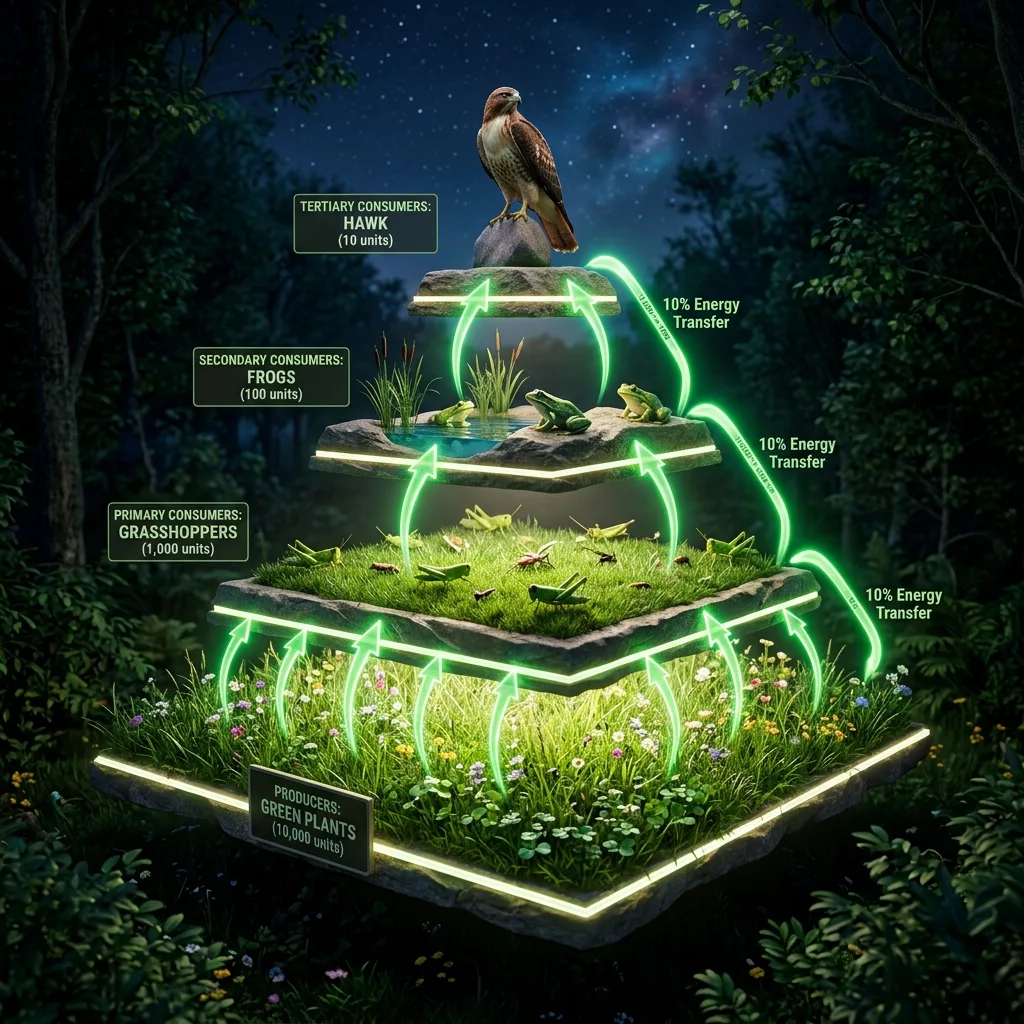
Enter the energy captured by producers (in Joules) and watch how it flows through the pyramid using the 10% rule!
- Food Chain: A linear sequence of organisms where energy transfers from one to the next — producers → herbivores → carnivores. Food Chain: Organisms का एक linear sequence जहाँ energy एक से दूसरे में transfer होती है — producers → herbivores → carnivores.
- 10% Rule: Only 10% of energy passes to the next trophic level; 90% is lost as heat. This limits food chains to 3–4 levels. 10% Rule: केवल 10% energy ही अगले trophic level तक पहुँचती है; 90% heat के रूप में lost हो जाती है। यह food chains को 3-4 levels तक सीमित करता है।
- Food Web: Interconnected food chains — more realistic than a single chain, as most organisms eat multiple types of food. Food Web: Interconnected food chains का जाल — यह single chain की तुलना में अधिक realistic है क्योंकि अधिकांश organisms कई types के food खाते हैं।
3. Ozone Layer Depletion (ओज़ोन परत का क्षरण)
Imagine you are standing under a giant umbrella that protects you from harsh sunlight (UV rays). That umbrella is the ozone layer. Now, some mischievous chemicals (CFCs) rise up and start poking holes in the umbrella. Sunlight starts pouring through the holes, burning your skin. The Montreal Protocol was like the whole world agreeing: "Let's stop making these chemicals so the holes can heal." सोचो आप धूप में एक बड़े छाते (umbrella) के नीचे खड़े हो, जो आपको तेज धूप (UV rays) से बचाता है। वह छाता ही ozone layer है। अब, कुछ शरारती chemicals (CFCs) ऊपर उठते हैं और छाते में छेद करने लगते हैं। इन छेदों से धूप सीधे नीचे आने लगती है और आपकी skin को जलाने लगती है। Montreal Protocol बिल्कुल ऐसा ही था, जहाँ पूरी दुनिया ने मिलकर तय किया: "चलो, ऐसे chemicals बनाना बंद करते हैं ताकि छाते के छेद अपने आप heal हो सकें।"
Ozone (O3) is a molecule made of three oxygen atoms. It forms a layer in the stratosphere (the upper atmosphere, 15–60 km above Earth's surface) [NCERT p.249]. Ozone (O3) तीन oxygen atoms से मिलकर बना एक molecule है। यह atmosphere की ऊपरी परत, जिसे stratosphere (समतापमंडल, Earth's surface से 15-60 km ऊपर) कहते हैं, वहाँ एक layer बनाता है [NCERT p.249]।
How Ozone Forms and Protects Us
High-energy ultraviolet (UV) radiation from the Sun splits oxygen molecules (O2) into free oxygen atoms [NCERT p.249]: Sun से आने वाली high-energy ultraviolet (UV) radiation oxygen molecules (O2) को free oxygen atoms (O) में split (तोड़) कर देती है [NCERT p.249]:
UV + O2 → O + O
These free atoms then combine with intact O2 molecules to form ozone [NCERT p.249]: ये free oxygen atoms फिर intact (अखंडित) O2 molecules के साथ combine होकर ozone बनाते हैं [NCERT p.249]:
O + O2 → O3 (ozone)
This ozone layer acts as a shield. It absorbs most of the harmful UV radiation from the Sun, preventing it from reaching Earth's surface [NCERT p.249]. Without the ozone layer, UV radiation would cause: यह ozone layer एक shield की तरह काम करती है। यह Sun से आने वाली अधिकांश harmful UV radiation को absorb कर लेती है और इसे Earth's surface तक पहुँचने से रोकती है [NCERT p.249]। अगर ozone layer न हो, तो UV radiation के कारण ये सब हो सकता है:
- Skin cancer in humans इंसानों में skin cancer होना
- Cataracts (damage to eyes) Cataracts (मोतियाबिंद / आँखों को नुकसान)
- Weakened immune system Weakened immune system (रोग resistanceक क्षमता कमजोर होना)
- Damage to plants and aquatic organisms Plants और aquatic organisms (जलीय organismों) को नुकसान
What is Destroying the Ozone Layer?
CFCs (Chlorofluorocarbons) are synthetic chemicals that were widely used in refrigerators, air conditioners, fire extinguishers, and aerosol sprays [NCERT p.249]. When released, CFCs rise to the stratosphere and break down ozone molecules. CFCs (Chlorofluorocarbons) ऐसे synthetic chemicals (मानव निर्मित रसायन) हैं जिनका बड़े पैमाने पर refrigerators, air conditioners, fire extinguishers, और aerosol sprays में उपयोग किया जाता था [NCERT p.249]। जब ये release होते हैं, तो CFCs stratosphere में ऊपर उठकर ozone molecules को break down (नष्ट) करने लगते हैं।
A single CFC molecule can destroy thousands of ozone molecules [NCERT p.249]. In 1985, scientists discovered a severe thinning of the ozone layer over Antarctica — known as the "ozone hole". एक single CFC molecule thousands (हजारों) ozone molecules को नष्ट कर सकता है [NCERT p.249]। 1985 में, scientists ने Antarctica के ऊपर ozone layer में एक severe thinning (भारी कमी) देखी — जिसे ozone hole (ओजोन छिद्र) के नाम से जाना जाता है।
International Action: The Montreal Protocol
The United Nations Environment Programme (UNEP) succeeded in getting nations to agree to freeze and phase out CFC production [NCERT p.249]. The Montreal Protocol (1987) was signed by many countries, committing to reduce and eventually eliminate CFC use. UNEP (United Nations Environment Programme) ने सभी देशों को CFC production को freeze और phase out करने के लिए मनाने में सफलता पाई [NCERT p.249]। Montreal Protocol (1987) कई देशों द्वारा sign किया गया, जिसमें CFC के उपयोग को कम करने और अंततः समाप्त करने की commitment की गई।
By 2010, most countries had successfully phased out CFCs [NCERT p.249]. The ozone layer is now slowly recovering — one of the greatest success stories in environmental protection! 2010 तक, अधिकांश देशों ने CFCs को पूरी तरह से phase out कर दिया [NCERT p.249]। Ozone layer अब धीरे-धीरे recover हो रही है — यह environmental protection की सबसे बड़ी success stories में से एक है!
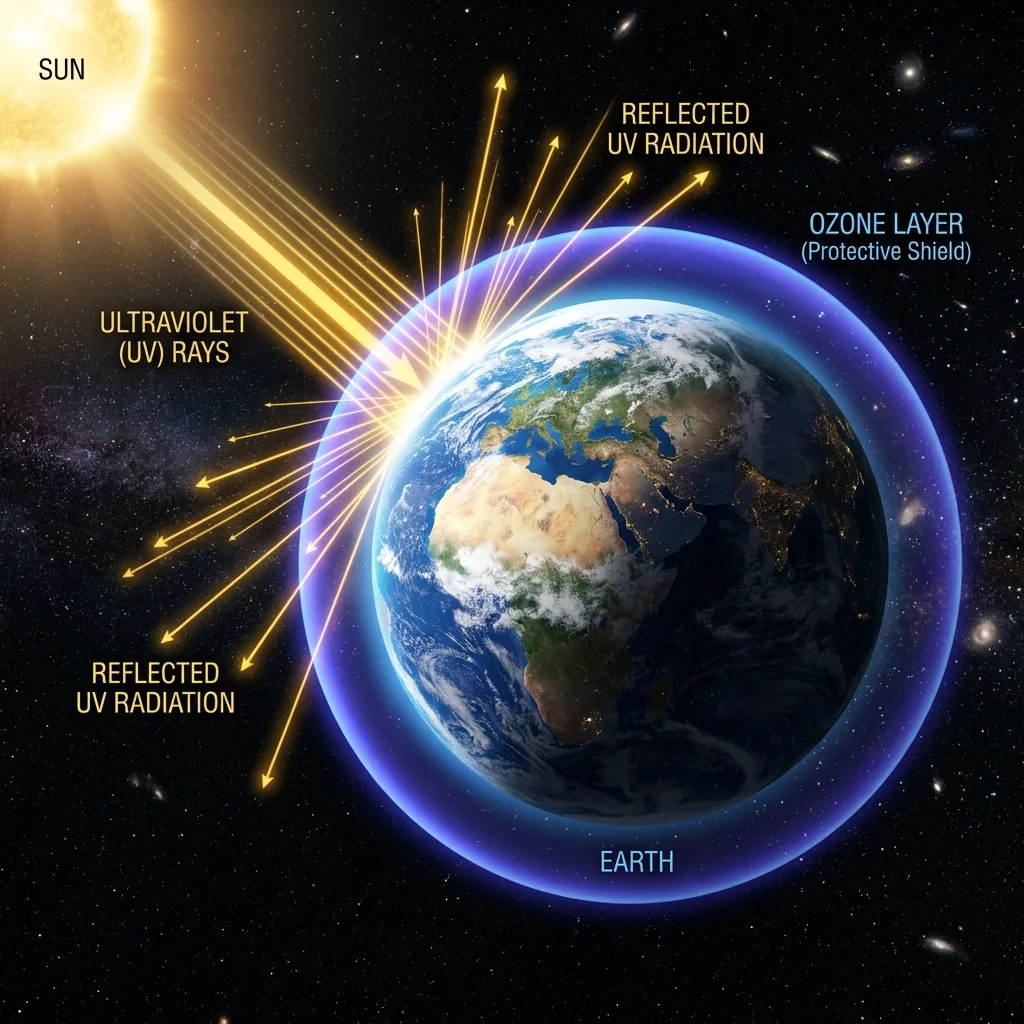
Rotate the 3D Earth globe by dragging. Toggle "UV Radiation" to shoot solar ultraviolet rays (purple) and watch them reflect off the shield. Click "Release CFCs" to spawn chlorine radicals (green spheres) that degrade the shield, letting UV rays strike the biosphere!
Ozone Shield Health: 100%
UV Penetration: 0% (Safe)
Chlorine radicals: 0 active
- Ozone (O₃): A protective layer in the stratosphere that absorbs harmful UV radiation from the Sun. Ozone (O₃): Stratosphere में एक protective layer जो Sun से आने वाली harmful UV radiation को absorb करती है।
- CFCs: Man-made chemicals used in fridges/ACs that rise to the stratosphere and destroy ozone. One CFC molecule can destroy thousands of O₃ molecules. CFCs: Fridges/ACs में इस्तेमाल होने वाले man-made chemicals जो ऊपर उठकर ozone को नष्ट करते हैं। एक single CFC molecule हजारों $O_3$ molecules को खत्म कर सकता है।
- Montreal Protocol (1987): International agreement to phase out CFCs. Most countries had done so by 2010, and the ozone layer is slowly healing. Montreal Protocol (1987): CFCs को phase out करने के लिए अंतरराष्ट्रीय समझौता। 2010 तक लगभग सभी देशों ने इसे लागू कर दिया, और अब ozone layer धीरे-धीरे heal हो रही है।
4. Managing the Garbage We Produce (कूड़े का प्रबंधन)
Drop a sponge (biodegradable) and a stone (non-biodegradable) into a pond. Over time, the sponge absorbs water, breaks apart, and dissolves — nature "digests" it. The stone sits at the bottom unchanged for centuries. Now imagine you keep throwing more stones into the pond every day. Eventually, the pond fills up with stones! That's what happens when we dump non-biodegradable waste like plastic into the environment. एक तालाब में एक sponge (biodegradable) and a stone (non-biodegradable) डालो। समय के साथ, sponge पानी सोखकर गल जाएगा और घुल जाएगा — यानी प्रकृति उसे "पचा" लेती है। लेकिन stone सदियों तक बिना किसी बदलाव के तालाब की तली में पड़ा रहेगा। अब सोचो अगर आप रोज तालाब में पत्थर फेंकते रहें, तो एक दिन तालाब पत्थरों से भर जाएगा! बिल्कुल ऐसा ही होता है जब हम plastic जैसी non-biodegradable चीजें अपने environment में फेंकते हैं।
Biodegradable vs. Non-biodegradable Waste
| Feature | Biodegradable (जैव निम्नीकरणीय) | Non-biodegradable (अजैव निम्नीकरणीय) |
|---|---|---|
| Definition | Broken down by bacteria, fungi, enzymes Bacteria, fungi और enzymes द्वारा आसानी से break down हो जाते हैं | Cannot be broken down by biological processes Biological processes द्वारा आसानी से break down नहीं होते |
| Examples | Food waste, paper, cotton, wood, cattle dung | Plastics, glass, metals, pesticides (DDT) |
| Time to decompose | Days to months Days से लेकर months तक | Hundreds to thousands of years (or never) Hundreds से thousands of years तक (या कभी नहीं) |
| Effect | Nutrients recycled back to environment Nutrients पर्यावरण में वापस recycle हो जाते हैं | Accumulate, pollute, enter food chains ये पर्यावरण में accumulate (इकट्ठा) होकर pollution फैलाते हैं |
Biological Magnification (जैव आवर्धन)
When non-biodegradable chemicals like DDT (a pesticide) enter a food chain, their concentration increases at each trophic level. This is called biological magnification [NCERT p.248]. जब DDT (पूरी तरह से non-biodegradable pesticide) जैसे chemicals किसी food chain में प्रवेश करते हैं, तो हर अगले trophic level पर इनकी concentration (सांद्रता) बढ़ती जाती है। इसे biological magnification (जैव-आवर्धन) कहा जाता है [NCERT p.248]।
How it works:
- DDT is sprayed on crops to kill pests. फसलों पर कीड़ों को मारने के लिए DDT spray किया जाता है।
- Rain washes DDT into rivers and lakes. बारिश के पानी के साथ बहकर DDT नदियों और झीलों में चला जाता है।
- Water absorbs a tiny amount of DDT. Water में DDT की बहुत tiny (सूक्ष्म) मात्रा घुल जाती है।
- Aquatic plants and plankton absorb DDT from the water. Aquatic plants और plankton पानी से DDT को absorb कर लेते हैं।
- Small fish eat many plankton and accumulate more DDT. Small fish बहुत सारे planktons को खाती हैं और उनके शरीर में DDT accumulate (इकट्ठा) हो जाता है।
- Large fish eat many small fish — even more DDT accumulates. Large fish कई small fish को खाती हैं — जिससे उनके शरीर में और ज्यादा DDT जमा हो जाता है।
- Birds (like eagles or pelicans) eat many large fish — they get the highest DDT concentration [NCERT p.248]. Birds (जैसे eagle) कई large fish को खाते हैं — जिससे उन्हें सबसे highest DDT concentration मिलती है [NCERT p.248]।
Effects: Eggshell thinning in birds, reproductive failure, cancer risk in humans [NCERT p.248]. Effects: Birds के अंडों के छिलके (eggshell) पतले हो जाना, reproductive failure होना, और इंसानों में cancer का risk बढ़ना [NCERT p.248]।
Watch DDT concentration increase at each trophic level. Use the slider to adjust the amount of DDT sprayed and see how it magnifies up the food chain!
The 3 Rs: Reduce, Reuse, Recycle
The best way to manage waste is to follow the 3R strategy:
- Reduce (कम करो): Use less. Avoid unnecessary consumption. Switch off lights and fans when not needed [NCERT p.249]. Reduce (कम करो): चीजों का इस्तेमाल कम करो। Unnecessary consumption से बचो। जरूरत न होने पर lights और fans बंद कर दो [NCERT p.249]।
- Reuse (पुनः उपयोग करो): Use things again without reprocessing. Use cloth bags instead of plastic bags. Refill water bottles instead of buying new ones [NCERT p.249]. Reuse (पुनः उपयोग करो): चीजों को बिना reprocess किए बार-बार इस्तेमाल करो। Plastic bags की जगह cloth bags का उपयोग करो। नई बोतलें खरीदने की जगह पुरानी पानी की बोतलों को refill करो [NCERT p.249]।
- Recycle (पुनर्चक्रण करो): Collect waste and convert it into new products. Paper, glass, and metals can all be recycled [NCERT p.249]. Recycle (पुनर्चक्रण करो): Waste को इकट्ठा करके उससे नए products बनाओ। Paper, glass, और metals को आसानी से recycle किया जा सकता है [NCERT p.249]।
- Biodegradable waste: Broken down by bacteria/fungi (food, paper, wood). Nutrients return to the soil. Biodegradable waste: Bacteria/fungi द्वारा आसानी से decompose होने वाला कचरा (जैसे food, paper, wood)। इससे nutrients वापस soil में मिल जाते हैं।
- Non-biodegradable waste: Cannot be broken down (plastic, DDT, glass). Persists in the environment and enters food chains. Non-biodegradable waste: जो decompose नहीं हो सकता (जैसे plastic, DDT, glass)। यह सदियों तक environment में रहकर food chains में प्रवेश करता है।
- Biological magnification: Concentration of toxins (like DDT) increases at each trophic level — top predators are most affected. Biological magnification: हर trophic level पर हानिकारक रसायनों (जैसे DDT) की concentration का बढ़ना — इससे top predators सबसे ज्यादा प्रभावित होते हैं।
NCERT In-Text & Exercise Solutions
In-Text Questions
Each step or level in a food chain where energy is transferred from one organism to the next is called a trophic level (पोषी स्तर).
Example food chain: Grass → Grasshopper → Frog → Snake → Eagle
- 1st Trophic Level: Grass (Producer)
- 2nd Trophic Level: Grasshopper (Primary Consumer / Herbivore)
- 3rd Trophic Level: Frog (Secondary Consumer / Carnivore)
- 4th Trophic Level: Snake (Tertiary Consumer)
- 5th Trophic Level: Eagle (Top / Quaternary Consumer)
Decomposers (bacteria and fungi) break down dead plant and animal remains into simpler inorganic substances. These nutrients are released back into the soil, water, and air, making them available for producers (plants) to absorb and reuse. Thus, decomposers act as nature's recyclers and are essential for nutrient cycling in the ecosystem.
Biodegradable substances (like food waste, paper, cotton) are made of natural organic molecules that bacteria and fungi have evolved enzymes to digest and break down.
Non-biodegradable substances (like plastics, glass, pesticides) are either synthetic chemicals that bacteria cannot recognize and break down, or inorganic substances that are resistant to biological decomposition. Since microorganisms do not have the necessary enzymes to act on these materials, they persist in the environment.
- Nutrient recycling: When biodegradable substances decompose, they release nutrients back into the soil, enriching it and supporting plant growth.
- Foul smell and disease: If biodegradable waste (like food scraps and animal remains) accumulates in large quantities without proper composting, it produces foul odours and breeds disease-causing organisms (pathogens), polluting the local environment.
- Biological magnification: Non-biodegradable pesticides like DDT enter food chains and their concentration increases at each trophic level, ultimately harming top predators (including humans) by causing cancer, reproductive failure, and eggshell thinning in birds.
- Pollution and accumulation: Plastics and other non-biodegradable materials accumulate in landfills, water bodies, and oceans, harming wildlife (animals choke on or get entangled in plastic) and contaminating soil and water for centuries.
Exercise Questions
(a) Grass, flowers and leather (b) Grass, wood and plastic (c) Fruit-peels, cake and lime-juice (d) Cake, wood and grass
- (a) Grass, flowers, leather — all are biodegradable (leather is made from animal skin, which decomposes).
- (b) Incorrect — plastic is non-biodegradable.
- (c) Fruit-peels, cake, lime-juice — all are biodegradable food products.
- (d) Cake, wood, grass — all are biodegradable organic materials.
(a) Grass, wheat and mango (b) Grass, goat and human (c) Goat, cow and elephant (d) Grass, fish and goat
A food chain requires organisms at different trophic levels where one eats the other. Grass (producer) → Goat (primary consumer / herbivore) → Human (secondary consumer / omnivore). Option (a) lists only producers. Option (c) lists only herbivores. Option (d) has no logical feeding link between grass, fish, and goat.
(a) Carrying cloth-bags (b) Switching off unnecessary lights (c) Walking to school (d) All of the above
(a) reduces plastic waste, (b) saves electricity and reduces fossil fuel burning, (c) reduces carbon emissions from vehicles. All three practices are eco-friendly as they follow the principle of Reduce.
Removing all organisms from one trophic level will disrupt the entire food chain:
- The organisms at the level below will overpopulate (no predators to control them).
- The organisms at the level above will starve and die (no food source).
- This imbalance cascades through the ecosystem, potentially collapsing the entire food web.
Yes, the impact differs:
- Removing producers: The most devastating impact — all consumers and decomposers would eventually die since producers are the foundation of all food chains.
- Removing primary consumers: Producers would overgrow, and all higher consumers would starve.
- Removing top consumers: The level below would overpopulate, but the overall ecosystem may stabilize over time.
Biological magnification is the progressive increase in the concentration of non-biodegradable chemicals (like DDT, mercury) at each successive trophic level of a food chain.
Yes, the levels are different at different trophic levels. The concentration increases as we move up:
- Water: lowest concentration (e.g., 0.003 ppm)
- Zooplankton: slightly higher (e.g., 0.04 ppm)
- Small fish: higher still (e.g., 0.5 ppm)
- Large fish: much higher (e.g., 2 ppm)
- Fish-eating birds: highest concentration (e.g., 25 ppm)
- Biological magnification: Non-biodegradable pesticides (DDT) enter food chains, with their concentration increasing at each trophic level, causing cancer, reproductive problems, and death in top predators.
- Environmental pollution: Plastics accumulate in landfills and oceans, harming marine life (turtles, fish, birds choke on plastic).
- Soil and water contamination: Heavy metals and chemicals leach from non-biodegradable waste into soil and groundwater, making them toxic.
- Long persistence: Since these materials don't decompose, they remain in the environment for hundreds to thousands of years.
No, even if all waste were biodegradable, it would still impact the environment if generated in excessive quantities:
- Large amounts of biodegradable waste can produce foul smell during decomposition.
- It creates breeding grounds for disease-causing organisms (flies, mosquitoes, bacteria).
- Decomposition releases greenhouse gases like methane (CH₄), contributing to global warming.
- Excessive organic waste in water bodies causes eutrophication — algal blooms that deplete oxygen and kill aquatic life.
Concern: The ozone (O₃) layer shields Earth from harmful ultraviolet (UV) radiation. If it is depleted, UV rays will reach the surface, causing:
- Skin cancer and sunburns in humans
- Cataracts and damage to eyes
- Weakened immune system
- Damage to crops and aquatic ecosystems
- The UNEP (United Nations Environment Programme) brokered the Montreal Protocol (1987) — an international treaty where nations agreed to freeze and eventually phase out the production and use of CFCs [NCERT p.249].
- By 2010, most countries had successfully phased out CFCs.
- Alternative, ozone-friendly chemicals have been developed for use in refrigerators and air conditioners.
- Use cloth bags instead of plastic bags for shopping — reduces plastic waste.
- Walk or cycle to school/market for short distances instead of using motor vehicles — reduces carbon emissions.
- Switch off lights, fans, and appliances when not in use — conserves electricity and reduces fossil fuel burning.
- Segregate waste into biodegradable (wet) and non-biodegradable (dry) bins — enables proper recycling and composting.
Solved CBSE Previous Year Questions (PYQs)
1 Mark Questions (MCQ / Very Short)
(a) DDT (b) Aluminium cans (c) Plastic bags (d) Cattle dung
Cattle dung is an organic substance that bacteria and fungi can easily decompose. DDT, aluminium cans, and plastic bags are all non-biodegradable.
2 Marks Questions (Short Answer I)
| Feature | Biodegradable | Non-biodegradable |
|---|---|---|
| Decomposition | Broken down by microorganisms | Cannot be broken down naturally |
| Time | Days to months | Centuries or never |
| Example | Vegetable peels | Polythene bags |
The 10% law states that only 10% of the energy available at one trophic level is transferred to the next level. The remaining 90% is used for life processes and lost as heat [NCERT p.244].
Calculation:
- Producers: 20,000 J
- Primary consumers: 20,000 × 10/100 = 2,000 J
- Secondary consumers: 2,000 × 10/100 = 200 J
3 Marks Questions (Short Answer II)
Biological magnification is the increase in the concentration of non-biodegradable harmful chemicals at each successive trophic level in a food chain.
Example: DDT (a pesticide) is sprayed on crops. It gets washed into water bodies by rain. Aquatic plants absorb small amounts of DDT. Zooplankton feeding on these plants accumulate more DDT. Small fish eating zooplankton accumulate even more. Large fish eating small fish accumulate still more. Finally, fish-eating birds (top predators) have the highest DDT concentration [NCERT p.248].
Why it is harmful for top predators:
- DDT is non-biodegradable, so the body cannot break it down or excrete it.
- Top predators eat many contaminated organisms over their lifetime, accumulating very high concentrations.
- This causes eggshell thinning (eggs break before hatching), reproductive failure, and increased cancer risk.
Formation: In the stratosphere, UV radiation from the Sun splits O₂ molecules into free oxygen atoms (O). These free atoms combine with O₂ to form ozone (O₃): O + O₂ → O₃. This process is continuous, creating a dynamic equilibrium [NCERT p.249].
Importance: The ozone layer absorbs most harmful UV radiation from the Sun, preventing it from reaching Earth's surface. Without it, UV radiation would cause skin cancer, cataracts, immune system damage, and harm to plants and aquatic organisms.
Montreal Protocol (1987): Scientists discovered that CFCs (used in refrigerators, ACs, aerosol sprays) were destroying the ozone layer. A severe ozone hole was found over Antarctica in 1985. The UNEP organised the Montreal Protocol, an international treaty where nations agreed to phase out CFC production to protect the ozone layer [NCERT p.249].
5 Marks Questions (Long Answer)
(b) Construct a terrestrial food chain with four trophic levels. Apply the 10% rule to calculate energy at each level if producers have 100,000 J.
(c) Why do food chains generally have only 3-4 trophic levels? [CBSE 2023]
(a) Ecosystem: A self-sustaining system of living organisms interacting with each other and with the physical environment [NCERT p.241].
Two components:
- Biotic (living): Producers, consumers, decomposers
- Abiotic (non-living): Temperature, sunlight, water, soil, minerals
Grass → Deer → Snake → Eagle
Applying the 10% rule:
| Trophic Level | Organism | Energy (J) |
|---|---|---|
| 1st (Producer) | Grass | 1,00,000 J |
| 2nd (Primary Consumer) | Deer | 10,000 J |
| 3rd (Secondary Consumer) | Snake | 1,000 J |
| 4th (Tertiary Consumer) | Eagle | 100 J |
(b) Explain the concept of biological magnification with an aquatic food chain.
(c) List two eco-friendly practices to reduce waste. [CBSE 2021]
(a) Harmful effects of non-biodegradable waste:
- Plastics pollute soil, water, and oceans — harming marine animals who mistake them for food.
- Pesticides like DDT enter food chains causing biological magnification — top predators suffer cancer, reproductive failure.
- Heavy metals contaminate groundwater, making it unsafe for drinking.
DDT sprayed on crops → washed into lake → absorbed by water (0.003 ppm) → phytoplankton (0.04 ppm) → zooplankton (0.5 ppm) → small fish (2 ppm) → large fish (10 ppm) → fish-eating bird (25 ppm).
The concentration increases at each trophic level because DDT is non-biodegradable and cannot be broken down or excreted by organisms [NCERT p.248].
(c) Eco-friendly practices:
- Use cloth bags instead of plastic bags (Reuse/Reduce).
- Segregate waste into biodegradable and non-biodegradable for proper recycling (Recycle).
☑ What You Can Now Do:
- Define ecosystem and identify its biotic (producers, consumers, decomposers) and abiotic components.
- Construct food chains, identify trophic levels, and calculate energy at each level using the 10% rule.
- Explain what a food web is and why it is more realistic than a single food chain.
- Describe how the ozone layer forms, why CFCs destroy it, and the role of the Montreal Protocol.
- Differentiate between biodegradable and non-biodegradable waste.
- Explain biological magnification with examples and why top predators are most affected.
- Apply the 3R principle (Reduce, Reuse, Recycle) in daily life.